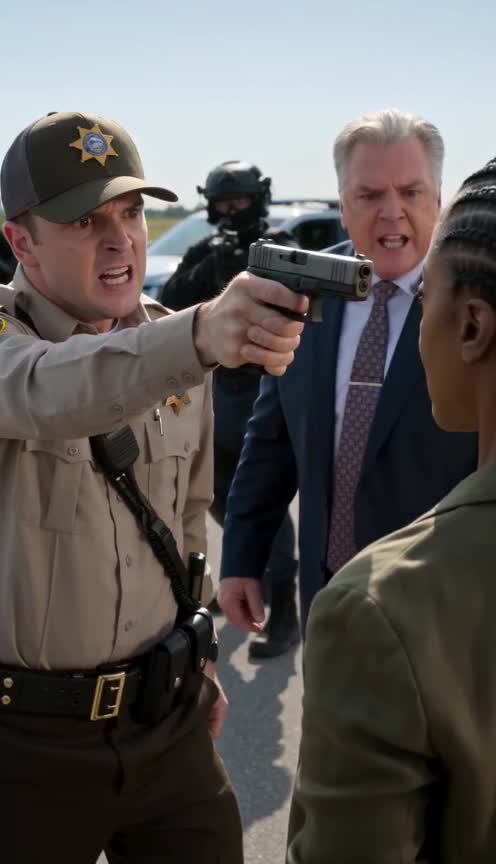
“Chapter 1: The Dark Stretch of Route Seventeen
You never realize how deafening the click of a cocked hammer is until it sounds two inches from your left ear, accompanied by the reek of cheap menthol tobacco and the unmistakable arrogance of a man who believes he is the undisputed law of the land.
My name is Simone Hartwell. If you pulled my personnel file from the Directorate of Operations at the George Bush Center for Intelligence in Langley, Virginia, you would find a clearance level that legally does not exist. You would find that I have coordinated black-site extractions in the Hindu Kush, outmaneuvered FSB surveillance teams through the frozen alleys of St. Petersburg, and spent fifteen years serving this country from within the deepest shadows of global statecraft. I had stared down cartel enforcers in Sinaloa without so much as an elevated pulse.
Yet here, on a desolate, pitch-black stretch of Georgia State Route 17 cutting through the suffocating humidity of Telfair County, none of those credentials meant a damn thing. To Georgia State Trooper Wade Kessler, I was just a Black woman in an old pickup truck, alone on an unlit highway surrounded by towering loblolly pines and stagnant swamp water.
I had come home on forty-eight hours of emergency personal leave. My father, Marcus Hartwell, was seventy-two years old, a retired Army combat engineer who had survived the Mekong Delta only to face down a battle he couldn’t outshoot. For three generations, the Hartwell family had farmed seventy acres of rich, alluvial riverfront land along the Ocmulgee River. It was fertile earth, paid for in sweat, blood, and honest toil. But six months ago, a consortium of state politicians and private developers had quietly begun buying up rural parcels to construct an interstate logistics corridor and a privately owned, state-contracted industrial depot.
Every family around my father had folded, pressured by eminent domain threats or seduced by lowball buyout checks. Marcus Hartwell refused. When zoning inspectors slapped him with fraudulent fines, he paid them out of his dwindling pension. When someone torched his hay barn two months ago, he cleared the smoking ashes with his tractor and planted winter rye in defiance.
Yesterday morning, my father had called me with a tremor in his gravelly voice that made my stomach drop. “Simone,” he had said, “the brakes went soft on the F-150 coming down Miller’s Ridge. If I hadn’t dropped her into second and dragged the tires against the ditch embankment, I’d be at the bottom of the gulley. Someone cut the lines, baby. They’re done asking.”
I took the first civilian flight out of Reagan National to Atlanta, rented an anonymous sedan, drove straight to the family homestead, and immediately took over. I spent the afternoon under the chassis of my father’s faded forest-green 1998 Ford F-150 in the gravel driveway, replacing the severed brake lines and bleeding the system myself. By ten o’clock at night, I took the truck out for an extended twenty-mile road test along the county bypass to ensure the hydraulic pressure held before handing the keys back to my father.
I was heading north back toward the farmhouse when the darkness behind me erupted into blinding, epileptic flashes of crimson and electric blue.
A standard cruiser had dropped in behind me without headlights, tailgating so close that its push bumper was mere feet from the Ford’s tailgate before flipping the emergency rack on. I didn’t panic. My tactical conditioning took over instantly. I signaled, eased off the accelerator, and pulled the truck completely onto the soft gravel shoulder, shutting off the engine and switching on the interior dome light. Both of my hands were resting flat and clearly visible at the ten-and-two position on the cracked steering wheel.
Every child of color in the South is taught the ritual. Move slowly. Announce your motions. Do not reach for anything. Keep your dignity intact, but keep yourself alive.
Heavy, deliberate boots crunched on the gravel outside the driver’s side door. The spotlight mounted beside the cruiser’s A-pillar flared into my side mirror, burning white against my retinas. Trooper Wade Kessler appeared in the doorframe, his Stetson tilted slightly forward, his right hand resting heavy and deliberate on the grip of his unholstered Glock 21. His uniform was immaculate, but his posture reeked of predatory anticipation.




