Chapter 1:
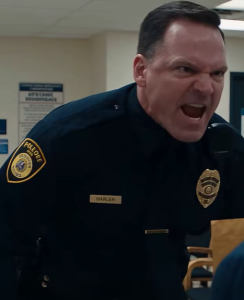
“YOU DON’T BRING SEALED DOCUMENTS INTO MY STATION!” THE POLICE SERGEANT SHOUTED BEFORE RIPPING OPEN A FEDERAL AUDITOR’S CONFIDENTIAL PACKET—THEN HIS FACE WENT PALE WHEN HE SAW HIS OWN NAME ON PAGE ONE.
He had snatched the envelope from a Black woman’s hands, accused her of hiding something, and torn through its official seal in front of the entire booking desk. But when he unfolded the first document, he discovered that the federal investigation wasn’t about someone else.
And the most disturbing detail wasn’t simply that his name appeared in the report—it was the confidential reference number printed directly beneath it, a number he recognized from an incident he believed had been buried months earlier.
“GIVE ME THAT ENVELOPE!”
Sergeant Robert Harlan slammed his palm against the counter.
Across from him stood a woman in a charcoal-gray suit.
Her name was Naomi Carter.
Forty-one years old.
A senior federal auditor assigned to review financial records and evidence-handling procedures at the county police department.
She had arrived carrying a sealed government packet.
And she had no intention of surrendering it to someone who wasn’t authorized to receive it.
“Sergeant, this packet is addressed to your department’s designated records custodian,” Naomi explained.
Harlan laughed.
“I’m the ranking officer here.”
“That doesn’t make you the designated recipient.”
The booking room went quiet.
Two officers stopped typing.
A civilian clerk looked up from her computer.
Harlan leaned forward.
“You think you can walk into my station and tell me what I’m allowed to see?”
Naomi remained calm.
“I’m asking you to follow the documented procedure.”
That was when his expression changed.
He reached across the counter.
Grabbed the packet.
And pulled it from her hands.
“SERGEANT, DO NOT BREAK THAT SEAL.”
He ignored her.
With one violent movement, he tore open the envelope.
The sound of ripping paper echoed through the room.
Naomi didn’t move.
She simply watched.
Because the moment Harlan broke the seal, he created a new problem for himself.
One that every person standing nearby had witnessed.
Harlan pulled out the documents.
“Let’s see what’s so important.”
He unfolded the first page.
Then stopped.
His eyes moved across the heading.
FEDERAL COMPLIANCE REVIEW — CONFIDENTIAL FINDINGS.
Below it appeared a name.
SERGEANT ROBERT HARLAN.
For several seconds, he didn’t speak.
The officers behind the counter exchanged confused looks.
Harlan stared at the paper.
Then looked toward Naomi.
“What is this?”
“A document you were not authorized to open.”
His jaw tightened.
He looked down again.
The report referenced discrepancies involving departmental funds, evidence records, and previously submitted internal documentation.
But one line caught his attention.
A confidential case reference.
He recognized it immediately.
Months earlier, an incident involving department property had generated questions that never seemed to reach a formal conclusion.
Harlan had believed the matter was closed.
He had believed the paperwork would remain buried inside the department.
Yet the same reference now appeared in a federal review.
And his name was printed directly above it.
“WHO GAVE YOU THIS INFORMATION?”
Naomi didn’t answer his demand.
Instead, she glanced toward the torn envelope.
“Sergeant, I need you to place those documents on the counter.”
Harlan gripped the pages tighter.
“Is someone in this department talking to you?”
Naomi’s expression remained unchanged.
“This is an official audit. The findings will be handled through the appropriate process.”
But Harlan wasn’t listening.
He was scanning the page.
Searching for names.
Dates.
Anything that might explain how the auditors had obtained information he thought no one outside the department would ever see.
Then he noticed a notation near the bottom.
SUPPORTING MATERIAL: PRESERVED ORIGINAL RECORDS.
His breathing changed.
Original records.
Not merely summaries.
Not just statements copied into an internal report.
The document indicated that source material had been preserved for review.
Naomi watched him carefully.
“Sergeant, put the packet down.”
He looked toward the two officers.
“Everybody get back to work.”
Neither moved immediately.
The civilian clerk stared at the torn seal lying on the counter.
Harlan lowered his voice.
“You don’t understand what you’re interfering with.”
Naomi met his eyes.
“I understand that you opened a sealed federal packet after being instructed not to.”
The room fell silent again.
Harlan looked at the first page.
His own name.
The confidential reference.
The preserved-records notation.
Everything he had wanted to keep away from outside scrutiny was suddenly in front of him.
And he had exposed it himself.
Then Naomi reached into her briefcase.
She removed a second document.
Unlike the packet Harlan had torn open, this one was already prepared for presentation.
She placed it on the counter.
“Sergeant, there’s something you need to understand about why I came here today.”
Harlan stared at her.
For the first time, he didn’t interrupt.
HE HAD TORN OPEN A FEDERAL AUDITOR’S SEALED PACKET TO PROVE HE CONTROLLED HIS STATION—ONLY TO DISCOVER THAT HIS OWN CONDUCT WAS PART OF THE REVIEW.
But Naomi’s next words could determine whether the documents represented an administrative problem or something much more serious.
WHAT HAD FEDERAL AUDITORS FOUND IN THE ORIGINAL RECORDS—AND WHY DID SERGEANT HARLAN RECOGNIZE A CONFIDENTIAL CASE NUMBER THAT WAS SUPPOSED TO HAVE BEEN FORGOTTEN?
Naomi placed two fingers on the second document.
“This is a formal preservation notice.”
Harlan stared at it.
“Preservation of what?”
“Financial records, evidence inventories, access logs, electronic communications, and related documentation covering the period under review.”
He gave a short, nervous laugh.
“You’re telling me how to run my department?”
“I’m notifying you of records that must not be destroyed or altered.”
Harlan glanced toward the booking computers.
Naomi continued.
“The department’s chief and designated records custodian have already received notice through official channels. This copy is for acknowledgment at the facility.”
The sergeant’s expression changed.
“Chief Warren knows about this?”
“Yes.”
Harlan looked down at the torn packet.
Then toward the civilian clerk.
“Nobody touches the computers until I say so.”
Naomi’s eyes narrowed.
“Sergeant, routine operations may continue. But no relevant records should be altered or deleted.”




