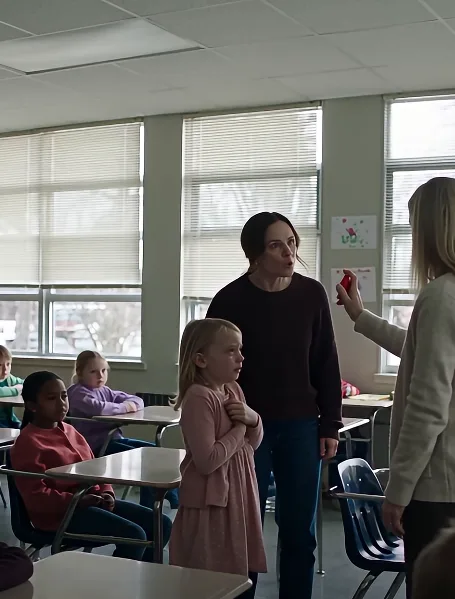
The morning had begun with the dull, metallic scent of an approaching frost. It was mid-November in Oak Ridge, the kind of Tuesday where the radiators inside Lincoln Elementary groaned and hissed against the draft rattling the single-pane windows.
In Classroom 2B, seven-year-old Maya Carter was sitting at the third desk in the second row, her small fingers curled tightly around a blue Crayola marker. Her coloring page—a turkey with exaggerated plumage—sat half-finished. Her teacher, Mrs. Evelyn Collins, was a woman whose presence was measured in sharp clicks: the click of her tortoiseshell heels against the waxed linoleum, the dry snap of chalk breaking against slate, the deliberate click of her tongue whenever a child dared to shuffle their feet out of rhythm.
Maya took a breath. It didn’t go down.
It caught somewhere behind her collarbone, rattling like dry autumn leaves trapped in a drainpipe. She swallowed, trying to force air past the invisible fist closing around her trachea. She knew this feeling intimately; it was the cold, tightening band of pediatric bronchial asthma.
Carefully, so as not to disturb the classroom’s mandated silence, Maya slid her small right hand into the side pocket of her purple backpack slung over the back of her chair. Her fingertips found the smooth, cool plastic of her albuterol inhaler. It was her lifeline, prescribed by Dr. Patel, stamped with bright orange medical warning stickers, and accompanied by a signed district medical accommodation form that sat—or was supposed to sit—in the school nurse’s filing cabinet.
Her fingers closed around the plastic canister. She pulled it onto her lap.
*Click. Click. Click.*
The tortoiseshell heels stopped at the edge of Maya’s desk. A long, manicured hand, pale and tipped with dull burgundy polish, reached down. Before Maya could lift the mouthpiece, Mrs. Collins’s fingers clamped over the blue plastic casing and ripped it away.
“What have I told you about toys during instructional time, Maya?” Mrs. Collins’s voice was smooth, quiet, and razor-sharp.
Maya looked up, her wide hazel eyes watering from the strain in her chest. “It’s… it’s not a toy,” she whispered, her voice already thinning into a papery wheeze. “My inhaler. I need it. Please.”
Mrs. Collins did not look at the medical label. She slipped the canister into the deep pocket of her gray cardigan. “You had recess twenty minutes ago. If you needed the nurse, you should have gone then. You don’t need this every time you feel uncomfortable.”
“Mrs. Collins… I can’t breathe.” Maya’s hands came up, instinctively clawing at the high collar of her cotton shirt, pulling the fabric away from her throat.
The teacher shook her head, folding her arms across her chest with an air of practiced, dismissive authority. “You are hyperventilating because you’re fixating on it. Children these days rely on gadgets and medicine for every minor inconvenience. You need to learn not to depend on it. Take deep breaths through your nose and finish your coloring.”
Maya tried. She closed her lips and pulled. Nothing entered. Her chest caved inward beneath her ribs, her intercostal muscles straining so hard they caused visible hollows at the base of her throat.
At the adjacent desk, a boy named Leo raised his hand timidly. “Mrs. Collins? Maya’s lips look funny. She doesn’t look okay.”
“Mind your own paper, Leo,” Mrs. Collins snapped without turning around. She walked back toward the chalkboard, picking up an eraser. “It’s just anxiety. If you indulge her, she’ll do it every day.”
Maya stood up. She didn’t mean to break the rules; her primal instinct simply screamed at her to find oxygen. She took half a step toward the teacher’s desk where her inhaler had been placed next to a neat stack of graded spelling tests.
She never reached it.
Her knees folded beneath her like wet cardboard. Maya struck the side of her desk, her coloring sheet fluttering into the air before her small body hit the floor with a dull, hollow thud.
The classroom went dead, terrifyingly silent.
“Maya?” Leo gasped.
Maya lay on her side, her back arching, her mouth open in a soundless, desperate gasp. Her fingernails, normally pale pink, were taking on the dusky, bruised hue of slate. Her eyes rolled backward toward the fluorescent lights humming overhead.
A girl in the back row began to shriek. “She’s falling! She’s not moving!”
“Everyone stay in your seats!” Mrs. Collins yelled, her voice finally losing its icy composure, replaced by a sharp, brittle panic. “Sit down! Right now!”
But eight-year-old Toby in the front row didn’t listen. He bolted from his seat, yanked the heavy classroom door open, and sprinted down the hall screaming for the nurse.
Chaos tore through Classroom 2B. Children stood on chairs, crying. Leo dropped to his knees beside Maya, tears streaming down his face as he grabbed her small hand. “Maya! Stay with me! Maya, look at me!”
Mrs. Collins stood frozen over the girl, looking down at the inhaler on her desk, then at the child convulsing slightly on the floor. Her hands trembled, but she did not pick up the medicine. She seemed paralyzed by the immediate, undeniable evidence that her theory had failed.
Seconds dragged into eternity.
Heavy footsteps thundered down the hall. Nurse Adams, an athletic woman in her forties, burst through the door, her medical kit swinging wildly. Toby was right behind her, red-faced and gasping.
“Out of the way! Move!” Adams barked. She dropped to her knees beside Maya, took one look at the child’s sunken ribs and cyanotic lips, and shouted: “Severe bronchospasm! Where is her rescue inhaler?!”
Mrs. Collins pointed a trembling finger toward the desk. “It’s… it was right there.”




