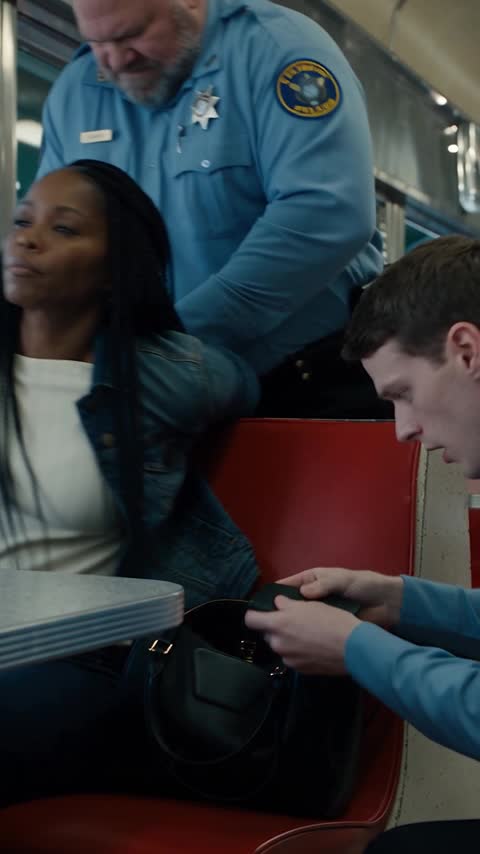
“Chapter 1: The Badge in the Bag
The diner smelled of scorched chicory, bacon fat, and forty years of unwashed grease trapped behind acoustic ceiling tiles. Outside, the midday Georgia heat rose off the asphalt of Highway 17 in shivering ribbons, blurring the pine line into a jagged emerald smudge.
Inside the booth, I took another sip of black coffee. It was lukewarm, bitter as quinine, and served in a thick ceramic mug with a chip on the rim. Beside my plate, a warm wedge of peach cobbler sat half-eaten, its crust golden and dusted with coarse sugar, swimming in melted cream.
Order the peach cobbler, she had told me on the phone last night. Her voice had been low, velvety, and filtered through the quiet hum of a state capitol office after hours. And be careful, Amara. Dalton Voss doesn’t play by Savannah rules.
I had smiled then. I wasn’t thinking about Savannah rules. I was thinking about the law.
Now, through the dust-streaked front window of the Dixie Belle Grill, I watched the white Ford Explorer turn off the highway without a turn signal. It didn’t crunch onto the gravel so much as tear through it, throwing up a rooster tail of pale limestone dust that coated the hood of my rental sedan. The cruiser wore no county markings on its passenger door, only a heavy brush guard, an array of black antennas whipping against the roof, and the gold seal of the Pellham County Sheriff’s Department emblazoned across the rear quarter panel.
The door swung open before the engine even settled into an idle.
Sheriff Dalton Voss stepped out first. He was fifty-eight years old, carrying two hundred and forty pounds of hard, bourbon-cured gristle wrapped in a dusty blue uniform shirt. His collar was damp with sweat, the gold six-point star pinned crookedly over his left pocket. He wore mirrored aviators that hid his eyes, but his mouth was a straight, cruel slit bracketed by graying stubble.
Behind him trailed his rookie. The boy couldn’t have been more than twenty-four, with a stiff neck, a buzz cut that showed too much pale scalp, and a duty belt that squeaked with every hurried step. His hand hovered reflexively near his holster, like a kid who had watched too many action movies and couldn’t wait to play out his favorite scene.
The diner went dead.
It wasn’t a gradual quiet. It was the sudden, suffocating silence of a pond when an alligator slips below the surface.
In the back corner, two elderly men in faded flannel caps stopped chewing their fried eggs. At the counter, a waitress holding a stainless-steel pot of decaf froze mid-pour, her eyes darting between the front door and the grease-spotted floor. Nobody looked at the deputies. Nobody looked at me. They simply drew their elbows in, lowered their gazes, and waited for the weather to pass.
I didn’t move. I picked up my fork, broke off a small piece of cobbler, and put it in my mouth.
The bell above the screen door gave a sharp, metallic jingle. The heavy timber of Voss’s combat boots rattled the linoleum floor. He didn’t look at the waitress. He didn’t acknowledge the old men. He walked with the heavy, unhurried stride of a man who owned the air everybody else was breathing.
He stopped three inches from the edge of my booth.
The rookie, wide-eyed and breathing through his mouth, posted up at the flank of the table, his fingers twitching against the black nylon of his belt.
“Ma’am,” Voss said. His voice was a low, gravelly scrape, like two cinder blocks grinding together.
I chewed my bite of cobbler, swallowed, and dabbed the corner of my mouth with a paper napkin. I looked up. All I could see in his mirrored lenses were two warped, distorted reflections of myself: a forty-four-year-old Black woman with braided hair pulled back into a neat knot, wearing a faded denim jacket over a white scoop-neck tee.
To Sheriff Dalton Voss, that was the entire dossier. That was the sum total of who I was.




