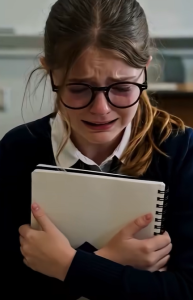
“Pick it up if you can,” Emma whispered, trembling as several students surrounded her near the classroom doorway. “Go ahead, record everything,” Brooks mocked, raising her phone while classmates nervously watched the confrontation unfold. “You don’t belong here,” Brooks continued, claiming the school belonged to her family. The new teacher entered suddenly, saw Emma cornered, and immediately asked, “What is happening here?”
“Everyone, step away from her,” the teacher commanded, positioning herself between Emma and the students. Brooks laughed and challenged her, saying, “You must be the new teacher, but this ends badly for you.” “Stay out of this,” Brooks shouted, believing her mother’s influence could protect her from consequences. The teacher remained calm and answered, “This ends now,” while the classroom slowly fell silent.
Brooks pointed toward her friends and ordered, “Get her,” but nobody moved after seeing the teacher’s determined expression. “Seriously?” Brooks snapped, realizing her usual intimidation suddenly wasn’t working. The teacher stepped forward and firmly said, “Walk away. This is your last warning.” Brooks refused and threatened, “You have no idea who you’re dealing with. My mother runs this school.”
Several students exchanged nervous glances as Brooks promised, “You’ll be fired before the end of the day.” The teacher looked directly at her and replied, “I didn’t come here to protect my job.” “I came here to protect my students,” she continued, making the room completely silent. Then she pointed toward Brooks and demanded, “Apologize to Emma,” refusing to accept another excuse. Brooks sighed dramatically and muttered, “Fine. Sorry,” expecting the confrontation to end immediately. “That wasn’t an apology,” the teacher replied, forcing Brooks to finally face the student she had humiliated. “Look at the person you hurt,” she ordered. “Power never makes cruelty acceptable.” Brooks slowly turned toward Emma, while the teacher addressed everyone watching from their desks. “When you stay silent, you help the bully,” she explained, making several students lower their eyes. One student quietly admitted, “I’m sorry,” while another finally put away their phone. The teacher asked, “How many of you helped her?” and nobody dared answer. Then the principal entered and requested, “Miss Brooks, may I speak with you outside?” Brooks smiled confidently, believing the principal would defend her family and punish the new teacher instead. Instead, the principal said, “I’ve seen this happen for far too long, and I should have acted sooner.” “We kept hoping bullying would stop by itself,” she continued. “It only gets worse when nobody acts.” The principal then offered the teacher her full support, saying, “Then let’s change this school together.”
Weeks later, the atmosphere at St. Jude High School wore an entirely new face.
Inside the newly established common room—a cozy space adorned with soft pastel-painted walls, comfortable sofas, and lush green potted plants tucked neatly in the corners—a quiet yet healing sharing circle was taking place. This was the “listening room,” a safe space proposed by Minh Anh herself to serve as a refuge for students who had previously felt invisible or endured psychological harm within the school environment.
Sitting on a long couch in the corner of the room, Emma relaxed her shoulders, taking a sip of warm tea from her mug. Looking around at familiar faces stripped of all hostility, she smiled softly—a smile that had been absent for months.
“There were times I genuinely hated waking up in the morning,” Emma shared slowly, her voice soft yet sincere amidst the quiet room. “Every step to school felt like torture. I felt completely alone among hundreds of people, as if my existence was just a joke for everyone else.”
Listening to every word from Emma across the room sat Brooks.
She sat quietly, hands tightly clasped in her lap. Gone was the arrogant demeanor, gone was the invincible armor; Brooks’s face now bore a contemplative expression and deep self-reflection. For the first time in her life, through Emma’s honest confessions, Brooks truly grasped the heavy weight of how deeply her impulsive actions had carved wounds into someone else’s soul.
A silence stretched, long enough for remorse to soak into every breath. Brooks lifted her gaze, hesitating for a moment before looking straight into Emma’s eyes.
“I… I genuinely didn’t know,” Brooks whispered, her voice trembling and choked with shame. “I never thought that what I did could suffocate someone else’s life like that.”
Minh Anh sat at a nearby table, smiling gently as she guided the moment: “Real change only begins when we dare to bravely face and accept responsibility for what we’ve caused, rather than hiding or seeking excuses.”
The teacher’s words acted like a catalyst, awakening the deepest conscience within Brooks. Without hesitating for another second, Brooks stood up and walked slowly over to Emma. She took a deep breath, swallowing her oversized ego to offer an apology born straight from the heart:
“Emma… I am truly sorry. I hurt you, and I was wrong.”
At that moment, the entire room seemed to stop moving. There were no cheers, no fake theatrics—only the earnestness of sincerity and forgiveness weaving into every corner. For the first time, the students present witnessed a power greater than any influence or authority in the world: the strength of choosing accountability over excuses.




