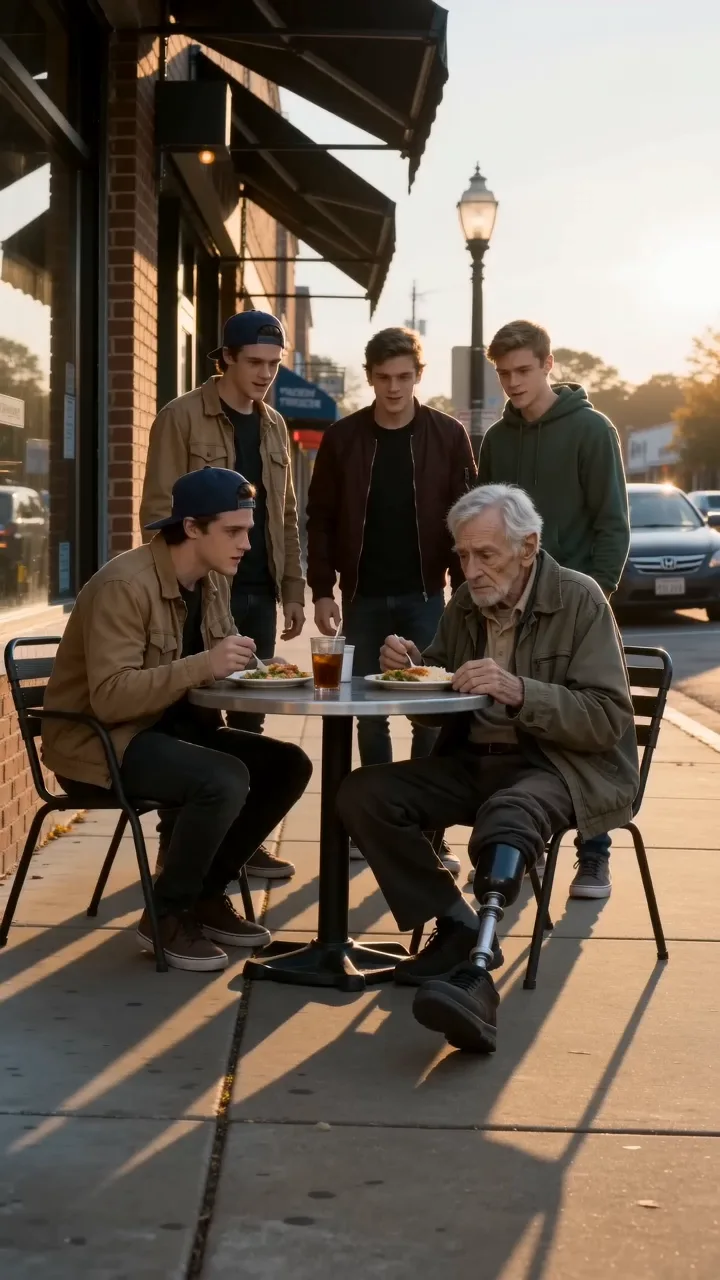
The late afternoon sun was beginning to disappear behind the buildings when an ordinary evening on an American sidewalk turned into a moment that would change four young men forever.
Outside a small neighborhood restaurant, an elderly man sat alone at a weathered table, quietly enjoying his meal. His clothes were simple, his movements slow, and one of his legs had been replaced by a prosthetic. He had learned to live with pain, inconvenience, and the stares of strangers.
But he had never learned to understand cruelty.
He wasn’t bothering anyone. He wasn’t asking for money. He wasn’t looking for trouble.
He was simply trying to eat his dinner in peace.
Then four young men approached.
They were loud, confident, and full of the kind of arrogance that comes from believing nobody will ever hold them accountable. They surrounded the old man, blocking his way out and exchanging mocking looks.
One of them glanced down at the elderly man’s prosthetic leg.
Another smirked.
Within seconds, their comments became louder, their laughter more aggressive, and their behavior more humiliating.
The old man lowered his eyes and tried to ignore them.
“Please,” he murmured, hoping they would lose interest and leave him alone.
But his quiet response only encouraged them.
One of the young men stepped closer to the table. Before the old man could react, the young man shoved it violently.
The table tipped over.
His plate crashed against the pavement. Food scattered across the sidewalk. His drink spilled beneath the chairs, and the sound of breaking dishes cut through the noise of the street.
For a moment, the elderly man simply stared.
His dinner was gone.
His hands trembled as he looked at the mess on the ground. He had barely touched his food. He had spent his money on that meal, and now everything lay scattered around his feet.
The four young men burst into laughter.
One pointed at the overturned table as if they had just witnessed the funniest thing imaginable.
Another shook his head, grinning at his friends.
None of them offered to help.
None of them apologized.
The elderly father slowly tried to stand. His balance was uncertain, and his prosthetic leg made the movement difficult. He reached for the edge of a nearby chair, but one of the young men stepped into his path.
The old man stopped.
He looked from one face to another, searching for even a hint of compassion.
There was none.
For the first time that evening, genuine fear crossed his face.
He was older than all four of them. He was outnumbered. He had no one standing beside him, and the people passing on the sidewalk seemed reluctant to get involved.
A few strangers glanced over.
One woman slowed her steps.
A man near the restaurant entrance frowned, but the young men were so aggressive that nobody seemed certain what would happen if they intervened.
The elderly father swallowed hard.
His fingers shook as he reached into his pocket and pulled out his phone.
One of the young men noticed.
“Who are you calling?” he asked mockingly.
The old man didn’t answer.
He searched for the number he knew by heart, the number of the person he trusted most in the world.
His son.
Across town, inside a modern American office building, the man’s son was working at his desk. A computer screen glowed in front of him, documents were spread across the desk, and his phone rested beside a notebook.
He was a middle-aged professional who had built his life around responsibility. His suit was immaculate, his schedule was full, and his days were often consumed by meetings and deadlines.
But no meeting had ever mattered more to him than his father.
When the phone rang, he glanced at the screen.
It was Dad.
He answered immediately.
On the sidewalk, the elderly man struggled to keep his voice steady. Behind him, the four young men continued laughing, unaware that the next few minutes would force them to confront the consequences of their actions.
The father pressed the phone close to his ear.
“Son, come to me.”
His voice was trembling.
There was no anger in those words. No threat. No demand for revenge.
Only a frightened father asking his son to come.
On the other end of the call, the son went completely still.
He recognized that voice.
He had heard it when he was a little boy and had fallen from his bicycle. He had heard it during difficult family moments, when his father tried to hide his pain so that nobody else would worry.
But he had never heard his father sound quite like this.
The son pushed his chair back.
“Okay Dad, I’m coming.”
He ended the call, grabbed his jacket, and stood up so quickly that his chair rolled backward.
A colleague looked over in surprise.
“Everything all right?”
The son was already moving toward the door.
“My father needs me.”
He didn’t waste another second.
He took the elevator down, crossed the lobby, and headed straight for his car. His mind was racing, but one thought remained clear.
His father had called for help.
And he would not leave him waiting.
Back on the sidewalk, the four young men had begun to notice the change in the elderly man’s expression.
He was still frightened, but something had shifted.
He no longer looked completely alone.
He held the phone in both hands and waited, occasionally glancing toward the street.
One of the young men folded his arms.
“What’s the matter? Your son coming to save you?”
His friends laughed again, though their laughter was quieter this time.
The elderly father said nothing.
He looked down at his scattered food and then back toward the road.
He wasn’t hoping his son would arrive to hurt anybody. He wasn’t asking him to start a fight.
He simply wanted someone who loved him to stand beside him.
The young men didn’t understand that distinction.




