The smell reached the emergency department hallway before the stretcher turned the corner.
I was finishing a note at the nurses’ station when June Whitcomb looked up from the medication cart. June had worked in emergency medicine long enough to recognize trouble from the way a paramedic walked. This time, she noticed the smell first. Her face changed, and she pushed the cart aside to clear a path into Trauma Room 2.
The boy on the stretcher was small for eight. He lay with his right arm across his chest and his cheek turned toward the rail. A fiberglass cast ran from his fingers to above his elbow. The material near the elbow was gray and brown. One edge looked damp. His exposed fingers were swollen and blue.
His mother followed the stretcher in a cream sweater, pearl earrings, and shoes that clicked sharply against the floor. She carried his jacket over one arm. Before the paramedic could finish giving his report, she said, “It’s the flu. He got dehydrated, and now everyone is making a fuss.”
The paramedic glanced at me. Owen Bell, eight years old. Fever at home, increasingly difficult to wake. His mother had called for an ambulance after he stopped answering her questions. His pulse was fast. His blood pressure was low. The paramedic had noticed the cast and the odor when he helped Owen onto the stretcher.
I introduced myself to Owen and Vivian Bell, then pulled a chair close enough that Owen could see my face without turning his head.
“Owen, I’m Dr. Ortiz. Can you tell me where it hurts?”
His eyes opened. They were dark and unfocused. He looked at his mother.
“He hasn’t wanted to talk,” Vivian said. “That’s what I mean about the flu.”
I checked his breathing, then touched his left hand. It was warm. His right fingertips, the ones beyond the cast, were cold. He made a small sound when I pressed one of them. The color returned slowly after I let go.
June read out his temperature. It was high. Malik Shah, the resident working with me that afternoon, was already checking the blood pressure again. I asked him to start our response for a child who might be in shock and to call the pediatric intensive care and orthopedic teams. June began placing an IV. We needed to treat Owen’s immediate illness while finding its cause.
I had worked eight years in emergency medicine. I had learned to be careful about the stories I told myself on first seeing a family. A spotless parent could be terrified and clumsy with words. An angry parent could have spent three nights awake beside a sick child. Appearance did not tell me what had happened to Owen.
His arm told me that the cast needed to come off.
“When was this put on?” I asked Vivian.
“Four weeks ago. Almost five. He broke his arm at a birthday party.”
“Where was he seen?”
“At the orthopedic clinic across town. They said another two weeks.”
“Has anyone looked at it since?”
“His regular doctor knows about it.”
That answer left a space where a date should have been. I asked Owen whether the cast felt tight. He barely nodded. Vivian leaned over him.
“You told me it itched,” she said. “Remember? You said it was itchy.”
Owen’s lips pressed together.
I drew Vivian a few steps away from the stretcher. I kept my voice low, though June and Malik needed to hear. I told her his circulation looked poor and that the fever and odor raised concern for a serious infection. The cast might be concealing the source. We needed to open it immediately.
“No.” She spoke quietly, with none of the uncertainty I usually heard from a parent facing frightening news. “You can give him fluids. You can bring down the fever. His orthopedic doctor handles the arm.”
“We’re calling that team too. Owen cannot safely keep this cast on while we wait.”
Vivian looked toward the elbow end of the cast. Then she straightened. “He’s terrified of saws.”
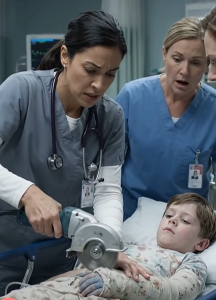
The cast saw frightened many children. I explained how we would protect Owen’s skin and take our time where it was safe to do so. I asked June to tell him what each step would feel like. Owen had closed his eyes again. I could not tell whether he had heard us.
Malik returned with the first supplies. June had the IV in place and was drawing the tests we needed. Other staff were moving around the bed now, each carrying out a piece of Owen’s care. Vivian alone stayed between the bed and the cabinet where the cast saw was kept.
“I’ll call his doctor,” she said.
“Please do.”
She took out her phone but did not dial. When June brought the saw over, Vivian’s expression changed. Color drained from her face.
“Don’t open it,” she whispered.
For a moment, I saw her watching the cast with a dread that had little to do with the sound of a saw. Then Owen moved, and I turned back to him. Whatever his mother feared, we could examine it later. He needed help now.
I asked Vivian to step back so we could work. She refused. When she raised her voice and reached across June toward Owen’s arm, June called security. An officer came to the doorway and asked Vivian to give us room. He did not touch her. She moved beside the wall, still close enough to see the bed.
June documented the cast’s condition and Owen’s visible injuries in the medical record. She wrote down Vivian’s account and the time we had heard it. I did the same. Neither of us knew yet why the cast looked as it did.
I knelt beside Owen. “This will make noise,” I told him. “You can hold June’s hand.”




