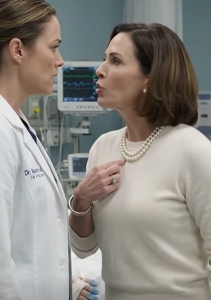
The woman beside the stretcher reached for my wrist before I touched her son’s cast.
“You can treat his fever,” she said. “You are not cutting that off.”
Her hand was cool. Her son was burning.
I pulled away and introduced myself again, slowly enough that there could be no confusion. I was Dr. Naomi Bell, the emergency physician responsible for his care. His name was Owen Whitaker. He was eight, and his right fingertips looked dusky beneath a cast that should have protected him.
He lay on the stretcher with his left hand tucked underneath his cheek. Even when the nurse adjusted his arm, he made almost no sound.
That frightened me more than screaming would have.
His mother, Celeste, wore a cream sweater and a pearl necklace. A leather handbag hung from her shoulder. She had arrived at our Ohio hospital in the middle of a wet Thursday afternoon, carrying a neatly organized insurance folder and a story about a virus.
The smell coming from her child’s arm did not belong to that story.
“How long has the cast been on?” I asked.
“Five weeks. Almost.”
“Any recent follow-up?”
“The specialist was satisfied.”
She answered quickly, looking at me instead of Owen.
Our charge nurse, Denise Alvarez, began checking his vital signs again. Peter, another nurse, moved toward the medication station after I gave the initial orders. I asked for the pediatric team and urgent surgical help. Owen needed care for a severe infection and the circulation problem in his arm. Neither could wait for us to settle an argument.
Celeste stepped closer to the stretcher.
“He gets dramatic when he’s uncomfortable. Please don’t encourage it.”
I looked at Owen. His eyes had opened at the word dramatic.
“What hurts most?” I asked him.
His mouth moved. Then he looked toward his mother.
“The whole thing,” he whispered.
Celeste gave a small, embarrassed laugh, as though he had complained about an unpleasant dinner.
I asked Denise to remain beside him while I examined what I could see. The fiberglass was dirty, with darker staining near the wrist. An uneven white wrap had been wound around its lower edge. His fingers were swollen.
“Who put this extra wrapping on?”
“It was coming apart.”
“Who put it on?”
“I did. Is that relevant?”
“Yes.”
I kept my voice level. A parent’s expensive clothes neither establish innocence nor prove guilt. I had treated neglected children whose families had money and frightened children whose parents could barely afford gas. What mattered was the child in front of me and the mismatch between his condition and the explanation.
“We need to remove the cast now,” I said.
“No.”
“Owen is seriously ill.”
“Then give him antibiotics.”
“We are treating the infection. We also have to find and relieve whatever is happening underneath.”
Her gaze dropped to the white wrapping. For the first time, I saw fear replace irritation.
Not fear when I mentioned infection. Not fear when I explained that the circulation to his hand was threatened.
Fear when I said underneath.
Years earlier, during my residency, I had accepted a father’s account of a toddler’s repeated falls too easily. A senior physician had returned to the bedside, asked different questions, and discovered injuries I had not adequately explained.
The child survived. I still remembered how relieved I had been when the father’s story first gave me permission to stop looking.
That memory did not tell me what Celeste had done. It reminded me to keep looking.
“Denise, document the appearance before removal,” I said. “Use the hospital equipment. We’ll need the findings photographed as part of his care.”
Celeste turned sharply.
“You’re taking pictures of my son?”
“Of the injury and the cast.”
“I haven’t consented to that.”
I asked our attending pediatric consultant to join us and requested the hospital’s child-protection team. There were people trained to handle questions I could not resolve while treating a critically ill child. I wanted them involved early.
When Celeste moved between Owen and Peter, Denise called security.
Nobody seized her or shouted. An officer asked her to step clear so the team could work. She refused twice, then backed toward the wall when the pediatric physician arrived and repeated that treatment could not be delayed.
“You don’t understand who my family is,” she said.
“I understand who my patient is,” I answered.
It was a sharper reply than I wanted. I took a breath and turned back to Owen.
I told him we were going to open the hard shell around his arm. I explained that the equipment would be noisy and that someone would stay beside him. I did not promise that nothing would hurt. Children notice when adults promise what they cannot control.
Denise offered him her hand.
He touched two of her fingers.
Then, just as the equipment was being positioned, he said something too softly for me to hear.
Denise leaned down.
“What was that, sweetheart?”
“I tried.”
“Tried what?”
“To tell.”
His mother took a step forward.
“He’s confused. He has a fever.”
Denise did not ask him to explain further. She said, “I heard you,” and stayed where he could see her.
We worked with the urgency his condition required. Another physician watched his response to treatment while I helped expose the arm. We opened the fiberglass and began separating the padding.
I expected neglected skin, infection, perhaps something pushed beneath the cast to scratch an itch.
What appeared beneath the added white wrap was a narrow black band.
It disappeared around his wrist.
For a moment, the room seemed to contract around that single detail. Peter stopped speaking in the middle of an update. Denise’s eyes moved from the band to Celeste.
Then we went on working.
It was a plastic cable tie, hidden beneath the extra wrapping at the lower edge of the cast. Its small locking head sat against the padding. It was much too tight.
Celeste spoke before anyone asked her a question.




