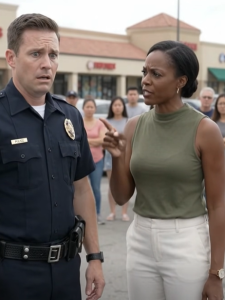
The afternoon sun beat down relentlessly on the asphalt of the Oakridge Market parking lot, baking the pavement and sending shimmering waves of heat rising into the humid Georgia air. It was a typical Saturday afternoon, characterized by the familiar, controlled chaos that accompanied the weekend grocery rush. Shopping carts with squeaky wheels rolled across the lot, their metal frames glinting in the bright light. Families, exhausted from the week but energized by the prospect of the weekend, loaded paper and plastic bags into the trunks of sedans and SUVs. Employees in their bright red vests moved briskly between the sliding glass entrance doors and the storage areas, corralling stray carts and assisting elderly customers. Cars of all makes and models came and went, exhaust fumes mingling with the scent of hot tar. It was a scene of ordinary suburban life, a tapestry of everyday routines weaving together in a shared public space. Nobody present that day could have expected that a seemingly minor, quiet argument near a parked police cruiser would escalate into the defining conversation of the community—a moment that everyone present would remember and dissect for years to come.
Ava Bennett had only planned to buy her weekly groceries. That was the entirety of her agenda. She had parked her reliable silver SUV near the front of the store, a lucky spot she had snagged just as another shopper was leaving. She grabbed a cart with a slightly wobbly front right wheel and walked inside, following the exact same routine she had executed nearly every weekend for the past three years.
Ava was thirty-one years old, a Black American woman with deep-brown skin that seemed to absorb the sunlight, calm and piercing dark eyes that missed very little, and sleek black hair neatly pulled back into a low, practical ponytail. She was the kind of person who moved through the world quietly and deliberately. This quietness was not born of timidity or a lack of confidence. On the contrary, she possessed a deep, unshakeable reservoir of self-assurance. She was quiet because she did not need external validation or attention to know her own worth. Professionally, she worked as a compliance investigator for a statewide oversight agency, a job that required a sharp analytical mind, a deep understanding of the law, and an unwavering commitment to ethics. But outside the walls of her office, she strictly avoided discussing her career. She never wore her credentials on a lanyard outside of the building. She never introduced herself by her impressive title or mentioned the authority she wielded in her day-to-day life. She firmly believed that every person she interacted with should treat her—and everyone else—fairly and respectfully, simply because it was the right thing to do, long before they knew anything impressive or intimidating about her professional status.
On this particular Saturday afternoon, Ava was dressed for comfort and anonymity. She wore a simple, well-tailored olive-green blouse, perfectly pressed cream-colored linen pants, small and understated gold hoop earrings, and comfortable leather walking shoes. Her black leather handbag, a sturdy and utilitarian piece, rested securely inside the child seat compartment of her shopping cart. Absolutely nothing about her demeanor, her attire, or the ordinary moment suggested trouble of any kind.
That is, until Officer Daniel Mercer laid eyes on her.
Officer Mercer was parked in his marked police cruiser near the supermarket’s main entrance, occupying a fire lane space for optimal visibility. He was forty-three years old, a white American police officer who had worked the patrol division for fifteen long years. He was a veteran of the force, a man whose reputation depended on who you asked. To some of his older, more traditional coworkers, he was a confident, proactive cop who didn’t shy away from confrontation. To others, especially the newer generation of officers, he was seen as a man too eager to prove himself, a relic of an era where dominance was valued over de-escalation. Mercer fundamentally believed that good police work meant acting quickly, trusting his gut, and taking control of a situation before it could develop. However, his critics within the department would quietly argue that he sometimes acted far too quickly, jumping to conclusions before gathering the necessary facts.
Earlier that afternoon, Mercer had been dispatched to Oakridge Market after a store employee called the non-emergency line to report a possible, highly unspecific shoplifting concern. The report was remarkably vague. A customer had allegedly left a fitting room area with an item that an employee felt “needed verification.” There was no clear description of the suspect provided—no race, no age, no clothing description. There was no confirmed theft, as no empty hangers or security tags had been found. There was absolutely no identified suspect. It was a ghost of a tip, the kind that usually resulted in a brief walk-through of the store and a return to patrol.
But when Mercer arrived and stepped out of his vehicle to stretch his legs, his eyes locked onto Ava as she walked out of the sliding glass doors and toward the parking lot, pushing her shopping cart. From his vantage point, he watched her pause, adjust her groceries, and place a small, crumpled paper receipt bag inside her cart next to her black handbag. Then, he watched her continue her measured pace toward her silver SUV. To Mercer’s trained, yet inherently biased eye, that simple sequence of mundane actions was enough to spark his interest. He decided, based on a nebulous feeling rather than objective evidence, that she was the suspect he was looking for.
He stepped fully out of his cruiser, his hand resting casually on his utility belt.
“Ma’am.”
Ava stopped pushing her cart. She turned her head slowly, her expression neutral.
“Yes?”
Mercer approached, closing the distance between them with heavy, authoritative steps. “Can I talk to you for a minute?”




