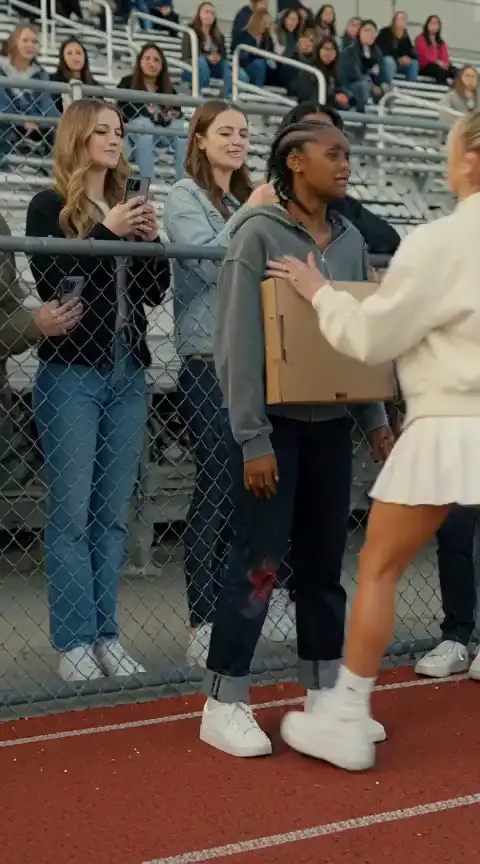
THE POPULAR SENIOR LAUGHED AS SHE GROUND A HELPLESS ART STUDENT INTO THE BLEACHER GRAVEL, BUT THAT CRUELTY BECAME THE BIGGEST MISTAKE OF HER LIFE AND KARMA HIT FAST.
The metal bleachers above us actually vibrated.
It wasn’t a school bus sound.
It wasn’t the rattling roar of the lifted trucks the varsity boys parked in the east lot.
It was a deep, chest-thumping hum, like an electrical substation waking up under heavy load.
Sierra didn’t move her foot off my canvas bag right away.
She kept that smug, half-bored grin plastered across her face.
“What, did your uncle borrow a tow truck?” she sneered.
Nobody laughed this time.
The circle around us had gone dead still.
The south service gate was supposed to be padlocked during school hours.
It was a heavy, twelve-foot industrial gate meant strictly for groundskeeping tractors and emergency ambulances.
The chain was hanging loose, swinging in the dry October wind.
Slipping through the opening came a vehicle that looked like it had been carved from a single block of obsidian.
It sat impossibly low to the asphalt, wide and predatory.
There was no chrome on it anywhere.
There was no front license plate.
There wasn’t even a dealership decal or a state inspection sticker on the tinted glass.
The finish didn’t reflect the midday sun; it seemed to drink the light right out of the air.
“What the hell is that?” whispered Jordan, the boy holding his phone over my shoulder.
His hand drifted down, the camera lens pointing at the grass.
“That’s an experimental chassis,” somebody behind him muttered.
“Bro, that’s not even commercially released.”
Sierra rolled her eyes and crossed her arms over her varsity cheer jacket.
“It’s probably just some booster showing off,” she snapped, though her eyes darted toward the fence.
“Some guy with a wrapped kit car trying to get attention.”
The matte-black machine didn’t rev.
It glided along the perimeter track with barely a whisper from its tires, crushing dead leaves beneath carbon-composite wheels.
It rolled straight past the visitor stands.
It didn’t stop in the visitor parking spaces.
It swung wide, drove right across the white chalk line of the track, and braked ten feet from where I was kneeling in the dirt.
The silence that followed was suffocating.
Four hundred kids were standing on the lower bleacher steps now, craning their necks.
Mr. Henderson stopped in his tracks, his clipboard dangling at his side.
For three seconds, nothing happened.
Then the gull-wing driver door lifted upward with a clean, mechanical hiss.
A man stepped out onto the red running track.
He had deep brown skin, the exact same shade as mine, and short graying hair cut razor-sharp at the temples.
He wore an oil-stained canvas work jacket over a plain dark henley, steel-toed boots that looked twenty years old, and a stainless steel mechanical watch with a battered leather strap.
His broad shoulders were set square against the wind.
He didn’t look at the crowd.
He didn’t look at the high school building or the banners.
His eyes locked instantly onto me, onto the red dirt smeared across my cheek, and onto my bleeding knee.
“Dad,” I whispered.
It wasn’t loud, but in that frozen stadium, the word carried.
Sierra let out a sharp, dismissive snort.
“Oh, perfect,” she said, stepping forward with her chin tilted high.
“You brought your mechanic dad in his boss’s company car.”
My father didn’t answer her.
He walked over, his heavy boots crunching softly on the cinders, and knelt down in the dirt right beside me.
He didn’t care about the red dust getting on his dark trousers.
He gently took my left hand, turning my palm upward to inspect the raw scrapes where the gravel had dug in.
His thumbs were rough and calloused, scarred from decades of engine blocks and milling machines.
“Did you drop the vase, Kendra?” he asked quietly.
His voice was deep, steady, and completely devoid of panic.
“She stepped on it, Dad,” I said, my chest hitching.
“I tried to tell her it was fired clay.”
“I told her it won the regional.”
My father looked down at the crushed cardboard box under Sierra’s platform shoe.
He reached out, his thick fingers carefully peeling back the torn tape.
Inside, the glazed black-and-copper vessel I had spent four months polishing was split into four jagged pieces.
He looked at the fragments for three full seconds.
Then he looked up at Sierra.
“Take your foot off my daughter’s work,” he said.
It wasn’t a yell.
It was delivered with the calm, terrifying weight of an iron door closing.
Sierra blinked, startled for a fraction of a second, before her usual sneer snapped back into place.
“Excuse me?” she laughed, planting her hands on her hips.
“Do you know who you’re talking to?”
“My father is Harrison Vance.”
“He owns Vance Automotive Group.”
“He owns six dealerships in this county alone, including the one that sponsors your daughter’s pathetic little art grant.”
My father stood up slowly.
He towered over her, six-foot-two of quiet, weathered muscle.
“I know who your father is, young lady,” my father said.
“Then you should know you’re trespassing on school property,” Sierra spat, glancing around to make sure her friends were watching her stand her ground.
“Mr. Henderson!” she called out loudly.
“This man drove an unauthorized vehicle onto the track and he’s harassing students!”
Mr. Henderson hurriedly trotted over, clutching his clipboard against his stomach.
His tie was flapping in the breeze, his face flushed red with administrative panic.
“Sir, sir, you need to back away immediately,” Henderson stammered, placing himself awkwardly between my father and Sierra.
“You cannot bring a motor vehicle onto the athletic field.”
“This is a restricted zone during the rally.”
“I will have school security escort you off the premises.”
My father looked at the vice principal’s badge pinned to Henderson’s sweater.
“Mr. Henderson,” my father said calmly.




