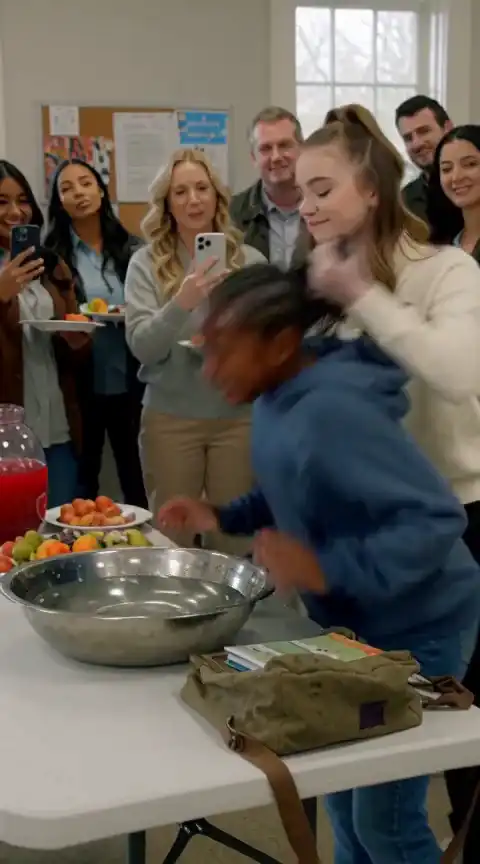
THEY MOCKED THE SCHOLARSHIP GIRL AS A NOBODY UNTIL THREE BLACK SUVS ROLLED THROUGH THE GATE, AND THE CROWD HAD NO IDEA WHAT WAS COMING.
The first man out of the lead SUV did not look at Kendra.
He looked through the community-center windows and counted the people inside.
A second man opened the rear door of the next vehicle.
He carried no weapon that anyone could see, but the room still changed around him.
Conversations died one by one.
The phone held by the boy near the doorway dropped an inch.
Kendra kept her hand in Amara’s wet hair because she had not yet understood that the audience was no longer hers.
“Get up,” she said.
Amara’s knees shook under her.
Water dripped from her chin onto the tile.
The black SUVs had stopped directly beside the entrance, blocking the view of the parking lot.
Their doors closed at the same time.
A man stepped out of the lead vehicle.
He was Black, broad-shouldered, and gray at the temples.
His dark coat hung open over a white shirt, and a thin scar ran from the edge of his jaw toward his collar.
He did not hurry.
That made the room more afraid.
Kendra’s mother lowered her plate.
Mrs. Danner whispered something to the woman beside her.
The woman shook her head.
Nobody knew the man, but somebody near the coffee urn did recognize the watch on his wrist.
“Wait,” he said.
It was the first thing he said, and it was only one word.
Kendra’s fist loosened.
Amara slipped free and caught herself against the counter.
Her old canvas bag lay open on the floor.
The stranger walked through the doors with two plain-clothes guards behind him and a woman carrying a black document case.
The guards did not scan the room dramatically.
They simply took positions near the exits.
That was enough.
The teenage boy who had filmed the dunk hid his phone behind his back.
The man’s eyes went to Amara.
His face did not break, but the color left it.
“Dad,” Amara said.
Kendra’s mother made a small sound.
Kendra stared at the man’s face, then at Amara, then back again.
“Your dad?”
Amara pressed both hands over her mouth because another cough was rising.
The man crossed the room.
He stopped before touching her.
“Can you breathe?”
Amara nodded.
“Did she hold you under?”
Amara looked toward the phones.
The boy near the doorway lowered his head.
“Yes,” she said.
The man turned to the room.
“My name is Calvin Whitfield.”
No one spoke.
Kendra’s mother knew the name before the others did.
She had heard it in board meetings, on procurement calls, and in the careful voices of people who wanted contracts renewed.
Calvin Whitfield ran Whitfield Defense Systems, a company whose equipment moved through military bases and federal warehouses across the country.
His contracts ran through the Pentagon.
His security team had federal clearance.
But none of that was why his voice made the room go still.
It was because he looked at the basin, then at his daughter’s soaked clothes, and did not shout.
“Show me the recording,” he said.
The boy with the phone swallowed.
Kendra stepped between them.
“You can’t come in here and threaten my family.”
Calvin looked at her.
“I asked for the recording.”
Kendra lifted her chin.
“This is a private school event, and you’re trespassing.”
“It’s a public community hall,” said the woman with the document case.
She placed a federal evidence tag on the table beside the basin.
Kendra’s mother stepped forward.
“Who are you?”
“Rachel Boone, compliance officer for Whitfield Defense Systems,” the woman said.
Kendra laughed, but the laugh came out too high.
“What does a company compliance officer have to do with a school party?”
Rachel opened the case.
“Your daughter’s phone was used to send a video from this room to three Eastbridge Prep administrators.”
Kendra’s smile disappeared.
Rachel removed a sealed plastic sleeve.
Inside it was a printed email chain, a small memory card, and a folded federal document marked with an evidence number.
“I received a preservation request forty-two minutes ago,” Rachel said.
Calvin did not look away from Kendra.
“From the moment my daughter called me.”
Kendra turned toward Amara.
“You called him?”
Amara’s hands trembled.
“I used the emergency shortcut.”
Kendra looked at the old phone on the floor.
Its cracked screen was still lit.
The room finally understood that Amara had not been silent because she was helpless.
She had been trying to survive long enough for the evidence to survive too.
Kendra’s mother reached for the memory card.
Rachel moved it out of reach.
“Don’t touch that.”
“I am on the foundation board,” the woman said.
“And the footage is now under federal preservation,” Rachel answered.
That sentence landed harder than a raised voice.
A man near the buffet whispered, “Federal?”
His wife grabbed his sleeve.
Calvin walked to the basin.
He placed one hand on its rim.
The metal still held the shape of Amara’s fingers in the water droplets.
Kendra crossed her arms.
“She was disrespectful.”
Calvin looked at Amara.
“Were you disrespectful?”
Amara shook her head.
“She laughed at my score,” Kendra said.
“That is not what I asked,” Calvin said.
Kendra’s mother stepped between them.
“This girl has been causing problems all semester.”
Rachel opened the printed email chain.
“Let’s read the complaints in order.”
The first page listed a failing participation score assigned to Amara after she had answered every question on a group presentation.
The second showed a teacher’s comment: scholarship students should be grateful for access, not demand equal attention.
The third contained a timestamp from the same afternoon.
At 3:14 p.m., Kendra had sent a message to a private student group.
It said, “Watch me clean the aid case before dinner.”
Mrs. Danner covered her mouth.
Kendra looked at her.
“You knew about that?”
Mrs. Danner’s face tightened.
“I saw the message.”




