Act I
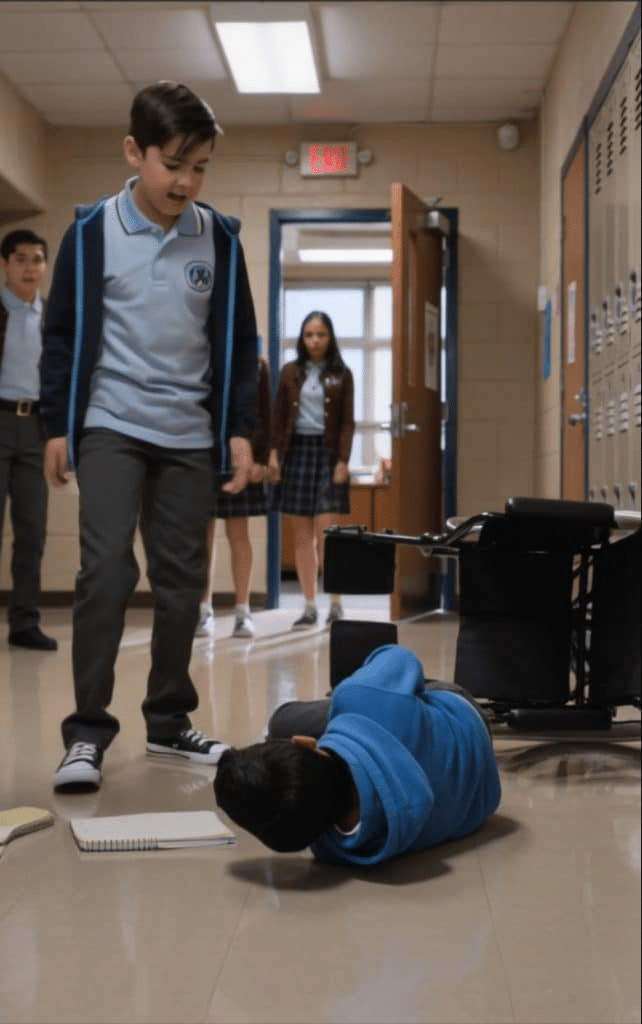
The hallway bell had barely stopped ringing when the wheelchair scraped against the polished floor.
It was a small sound.
A quick scrape near the low lockers, almost swallowed by the rush of sneakers, backpacks, and children hurrying between classrooms.
But the older boy heard it.
He had been running down the hallway with two friends, laughing too loudly, shoulders wide with the careless confidence of someone used to being watched.
His leg clipped the front wheel of a smaller boy’s wheelchair.
He stumbled.
Not badly.
Not enough to fall.
Just enough to make his friends look at him.
That was all it took.
The smaller boy froze close to the wall, both hands still on the wheel rims, notebooks stacked across his lap.
He was ten years old, wearing a blue hoodie, his eyes wide with the fear of someone who already knew what anger could become.
He had done nothing on purpose.
He had only tried to stay out of the way.
But the older boy turned back as if he had been attacked.
His face twisted with rage.
The hallway around them slowed.
Children stopped near the lockers.
A teacher’s voice echoed faintly from another corridor.
Then the older boy stepped back, planted one foot hard against the floor, and drove his other foot straight into the boy’s stomach.
The impact threw the child backward out of the wheelchair.
His notebooks flew from his lap.
His small body hit the floor on his back and side.
The wheelchair shot backward, twisted sideways, and crashed over with a metal clatter that made the entire hallway gasp.
One wheel kept spinning.
A notebook slid all the way to the lockers.
The boy lay on the floor, breath knocked from him, one palm scraped, one cheek red from the impact.
His eyes filled with frightened tears.
But he did not beg.
The older boy stepped over the scattered papers and leaned down with bared teeth.
“Trash. You slow everyone down.”
The words hit the hallway almost as hard as the kick.
Then he moved closer again.
And behind the closed principal’s office door, a father was about to hear the sound that would change everything.
Act II
The boy’s name was Noah Bennett.
He was quiet by nature, not because he had nothing to say, but because he had learned that quiet made hallways easier.
He knew which side of the corridor had fewer backpacks on the floor.
He knew which classroom doors opened too suddenly.
He knew how to turn his wheels carefully so he did not bump into other children rushing past.
Most days, he tried to take up less space than he needed.
That was the part that would have broken his father’s heart if he had seen it sooner.
Noah did not want special treatment.
He wanted not to be treated like a problem.
He loved science books, space drawings, and the smell of new pencils. His notebooks were filled with planets, rockets, math problems, and small sketches of buildings with ramps wide enough for everyone.
He kept those notebooks on his lap because they made him feel prepared.
Because in school, a child like Noah learned to be prepared for everything.
The older student’s name was Tyler.
He was thirteen, taller than most kids in his grade, and proud of the school team shirt he wore like armor.
He liked having friends behind him.
He liked laughter that made him feel bigger.
He liked the way younger students moved aside when he came fast down the hall.
Before that morning, teachers had called his behavior “rough.”
They had called it “showing off.”
They had called it “needing guidance.”
But cruelty has a way of growing when adults name it too softly.
Tyler had learned that a smirk could become a shove, a shove could become a threat, and a threat could disappear if nobody wanted paperwork.
So when he clipped Noah’s wheelchair and embarrassed himself in front of his friends, he did not see a child.
He saw a target.
After the first kick, the hallway waited for him to stop.
He did not.
Noah curled inward, clutching his stomach and side, trying to breathe without making too much sound.
That silence seemed to give Tyler more room to be cruel.
He stepped close and kicked him again.
Once into his lower back.
Then into his side.
The children watching gasped louder the second time.
One little girl began to cry.
A teacher at the far end of the hall turned toward the commotion, but the moment had already become something no one could undo.
Tyler pointed down at Noah like he was not a student, not a child, not a person.
“Stay down where you belong.”
Noah’s hand tightened around the sleeve of his hoodie.
His eyes were wet.
His breath came fast.
But still, he did not beg.
He only stared at the floor where his notebook had fallen open to a drawing of the school building.
A building his father owned.
And the office door at the end of the hallway had just slammed open.
Act III
The first adult through the door was not the principal.
It was the man in the dark suit.
The principal followed behind him, face pale with shock.
Two school security staff stepped out next, their expressions changing as soon as they saw the overturned wheelchair, the scattered notebooks, and the small boy on the floor.
The man in the suit stopped for only half a second.
His eyes found Noah.
The scraped palm.
The red cheek.
The way his son was curled beside the tipped wheelchair, trying to make himself smaller even after being hurt.
Then he moved.
Fast.
He crossed the hallway while students parted instinctively.
He did not look at Tyler first.
He did not ask who started it.
He went straight to his son.
“Noah.”
The word came out low and strained.




