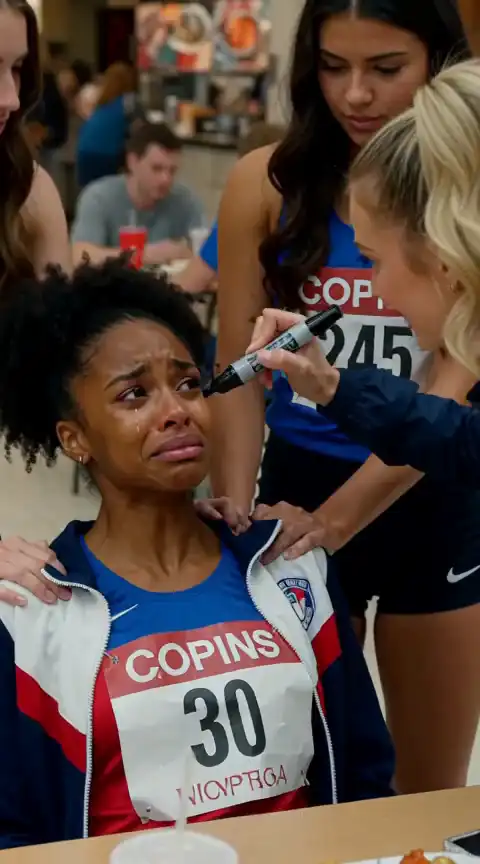
A SCHOLARSHIP RUNNER WAS PINNED DOWN AND BRANDED WITH BLACK INK IN A PACKED MALL FOOD COURT — BUT THE SNOBBY RIVAL HAD NO IDEA WHO HER FAMILY REALLY WAS.
Simone did not wipe her face.
She sat perfectly upright in the cheap molded plastic chair while the greasy black solvent dried tight against her cheekbone.
Around the food court atrium, the laughter hung in the air like stale grease.
Whitney Calloway was still waving the uncapped industrial marker in her right hand, admiring her handiwork while her phone recorded every second.
“Look at her,” Whitney said to the circle of varsity sprinters crowding around the table.
“She actually thinks she can show up to Monday’s regional registration with that face.”
The two girls holding Simone’s shoulders finally let go, shaking out their wrists as if touching Simone’s faded windbreaker had soiled their fingers.
Simone reached up slowly, touched the edge of the dark pigment beneath her left eye, and drew her fingertips back.
The ink had already set.
It was a thick, jagged zero, scratched hard enough to leave angry red welts along the borders of her deep brown skin.
“You should thank me,” Whitney sneered, tossing the marker onto the tray between two half-eaten baskets of fries.
“Now nobody at the invitational has to ask who the charity case is.”
Coach Danvers was still standing forty feet away by the smoothie counter, pretending to study his paper receipt.
He had seen every second of it.
He had seen Whitney shove Simone into the chair.
He had seen the sprinters pin her arms.
He had seen the marker come out.
Yet he kept his back turned, adjusting his team polo shirt that bore the embroidered logo of Calloway Logistics across the chest.
Simone stood up.
Her legs were steady, even after running four brutal preliminary heats in worn-down spikes that had cost her three weeks of wages at the auto parts depot.
She picked up her canvas gym bag from the floor.
“You’re not running on that relay team, Hendricks,” Whitney called after her, her voice echoing off the mall’s glass dome.
“My dad already told the state committee that our club doesn’t sponsor runners who can’t cover their own travel insurance.”
Simone stopped and turned her head slightly.
“The state qualifying time belongs to me, Whitney.”
“Not after Monday it doesn’t,” Whitney laughed, surrounded by teammates nodding in practiced agreement.
“Rules are written for people who can afford the ink they’re printed on.”
Simone didn’t answer.
She walked past the smoothie counter, her eyes never wavering.
Coach Danvers cleared his throat as she passed, trying to avoid her gaze.
“Hendricks,” he muttered under his breath, barely moving his lips. “Don’t make a scene out of this. You know how Whitney gets when she’s stressed before finals.”
Simone paused, looking right through his mirrored sunglasses.
“You watched her do it, Coach.”
“I didn’t see anything except teammates horseplaying after a meet,” he said quickly, checking over his shoulder to make sure Whitney wasn’t listening.
“Go home, wash your face, and let’s talk about the backup alternate spot on Tuesday.”
“I’m not an alternate,” Simone said quietly.
“I beat her by two-tenths of a second.”
“Times can be adjusted on the official sheet if there are equipment discrepancies,” Danvers said, his voice hardening into a warning.
“The Calloways donated our entire track surface, kid. Be smart.”
Simone didn’t argue.
She pushed open the heavy glass exit doors and walked out into the humid afternoon heat.
In the parking lot, the asphalt radiated warmth against the thin soles of her running sneakers.
She pulled out her cracked smartphone and looked at her reflection in the dark screen.
The black zero was stark and ugly against her dark brown cheek, stretching from just below her temple down to the corner of her jaw.
Her phone buzzed in her palm.
It was an incoming call from a number that didn’t appear in public directories.
She swiped the screen.
“Dad,” she said.
“Simone, where are you?” Aaron Hendricks asked, his voice low, steady, and carrying the clipped rhythm of an operating theater.
“Outside the mall entrance by the transit stop.”
There was a three-second silence on the line, the kind of silence that usually preceded an emergency room code.
“Your mother saw the video,” Aaron said.
Simone tightened her grip on the strap of her canvas bag.
“Whitney posted it already?”
“Ten minutes ago,” Aaron replied. “It has twelve thousand views on the high school athletic network. Her caption says you received your true market value.”
Simone closed her eyes for a single heartbeat, taking in the heat of the sun.
“I won the race, Dad.”
“I know you did, sweetheart,” he said softly. “I watched the live timer from the surgical suite between cases.”
“They’re taking the spot away anyway,” Simone whispered. “Coach Danvers said they’re altering the official heat sheet.”
“Did he?” Aaron’s voice dropped an octave, losing every trace of parental softness and taking on the chilling precision of a man who held the fates of multi-million-dollar medical boards in his hands.
“Stay right where you are.”
“Dad, you don’t have to leave the hospital—”
“I am not leaving the hospital by car, Simone.”
Before she could ask what he meant, the call disconnected.
Inside the mall, Whitney and her friends were already walking out toward the parking lot, laughing loudly as they gathered around Whitney’s brand-new white convertible.
Whitney saw Simone sitting on the low concrete curb near the bus shelter and pointed her phone again.
“Look, the zero is waiting for the public bus!” Whitney shouted, making sure the passing shoppers heard every word.
Several elderly shoppers frowned, but nobody stepped in to challenge the daughter of the town’s most prominent investor.
Whitney strutted over, swinging her car keys on a designer lanyard.
“Still haven’t washed it off?” Whitney taunted, stopping six feet away with her squad fanning out behind her.




