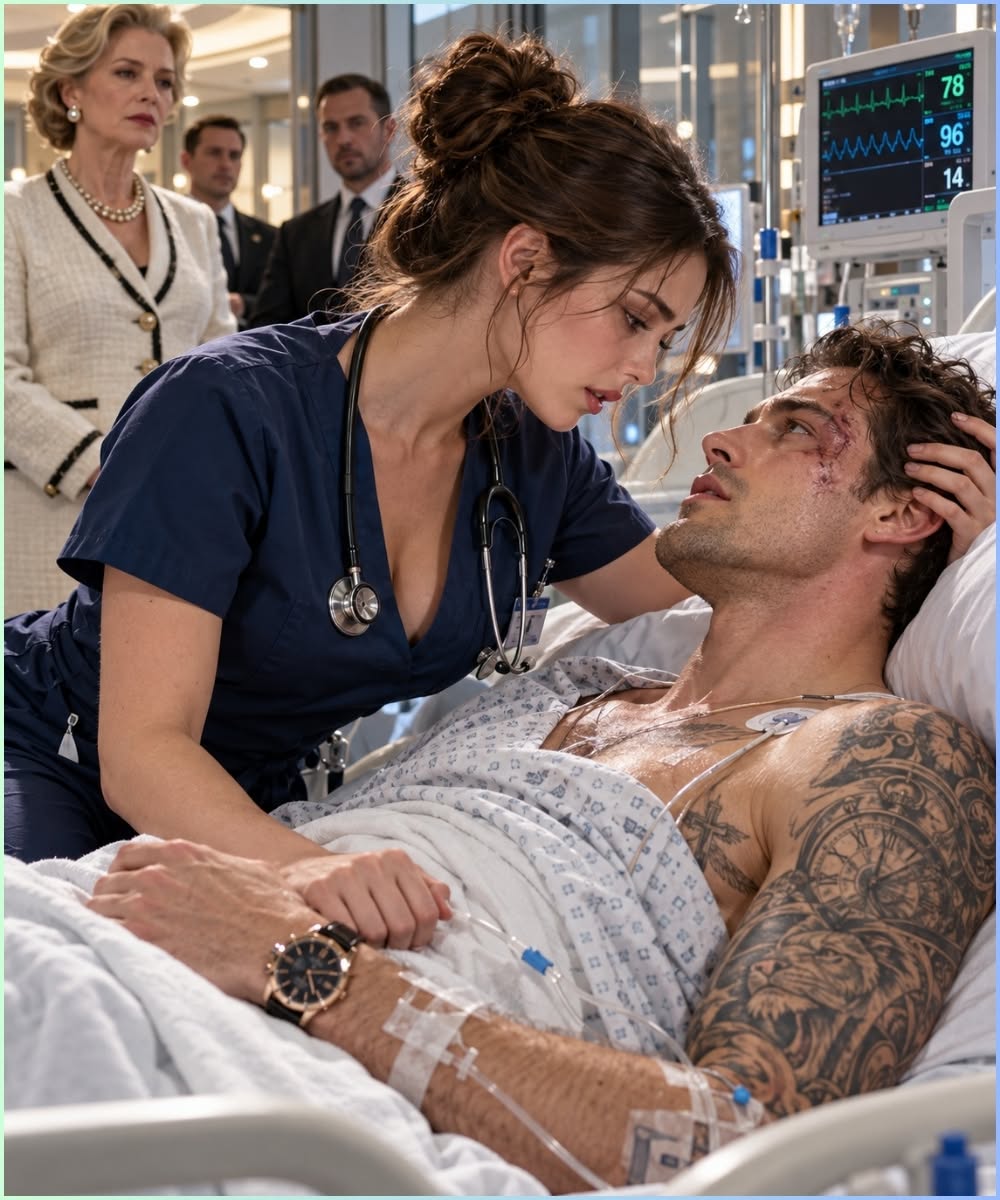
The first thing Maya Bennett noticed about the dying man was that his watch was still ticking.
Everything else about him looked broken.
His pristine white dress shirt had been brutally sliced open from collar to hem by the responding paramedics, revealing a chest that heaved with ragged, unstable breaths. Rainwater mixed with darkening blood plastered thick strands of dark hair to his forehead. A massive, purplish bruise spread from his left temple down toward his cheekbone, and tiny, sharp shards of shattered windshield glass glinted like cursed diamonds along his collarbone under the blinding neon lights of the emergency room.
Yet, despite the chaos and the violent stench of copper, rain, and burned rubber, the polished silver watch on his left wrist maintained its rhythmic, unyielding pulse.
Tick.
Tick.
Tick.
It was a heavy, mechanical timepiece, likely handcrafted in Switzerland, operating on kinetic energy. As long as the man’s body shuddered, the tiny internal gears turned. It was as though somewhere inside the shattered architecture of Trauma Bay Nine, time itself refused to surrender him to the dark.
“Male, approximately thirty-five!” shouted the lead paramedic over the harsh, rhythmic beep of the cardiac monitors as they transferred the patient onto the hospital gurney. “Single-vehicle rollover on Route 18. Car went straight through the guardrail and plunged forty feet down an embankment. High-speed impact. No wallet found. No phone located in the wreckage. Zero identification!”
“Systolic pressure dropping fast—eighty over forty!” a triage nurse yelled, hooking up a bag of saline.
“Check the pupils!” shouted Dr. Harold Keene, the attending trauma physician, stepping up to the head of the bed with his penlight drawn.
“Left pupil is sluggish, right is blown!” someone called back.
Maya pulled on a pair of tight blue nitrile gloves, stepped into the space beside the gurney, and placed her hands firmly on either side of the stranger’s neck to stabilize his cervical spine. The heat radiating off his torn skin was alarming, laced with the sharp, cold moisture of the autumn storm raging outside St. Catherine’s Hospital.
“Sir? Can you hear me?” Maya leaned down, her voice clear, firm, and deliberately grounding. “Sir, stay with me. You’re at St. Catherine’s. You’ve been in an accident.”
There was no verbal response. His face possessed the severe, sharp symmetry of someone who had never known the indignities of dental distress or untreated illness—a jawline cut from granite, high cheekbones, and skin that betrayed a life lived far away from heavy manual labor. But wealth, pedigree, and status were stripped of all utility the moment a human airway began filling with blood and fluid.
“Get trauma chest tubes ready!” Dr. Keene commanded, scanning the chest X-ray that had just flashed up on the digital screen. “He’s got a tension pneumothorax on the left, cracked ribs four through seven, and a closed head injury. I want CT scan on standby the second we stabilize this pressure!”
The room dissolved into a frantic, highly choreographed dance of trauma medicine. Syringes were prepped, suction tubes rattled violently, and intravenous lines were hammered into both of his arms.
Maya kept her gloved hands planted firmly on the sides of his blood-stained face. She felt the micro-tremors in his neck muscles, the violent struggle of a nervous system undergoing catastrophic shock.
“Stay with us,” she whispered softly, leaning in close so her voice wouldn’t be swallowed by the metallic shouting of the trauma team. “Just stay right here.”
Underneath her right palm, against the damp cotton of the neck brace, his fingers twitched.
It wasn’t a purposeful movement; it was a reflex, a desperate clawing at consciousness by a brain drowning in trauma. But Maya caught it. In the chaos of the ER, where nurses and doctors focused on numbers, blood gas levels, and millimeter readings of pupillary response, Maya always looked for the human thread.
“There you are,” she murmured, her tone softening just enough to carry a warmth that no machine could measure. “Come on. Don’t go anywhere. Fight it.”
She had been on her feet for thirteen relentless hours.
The soles of her feet felt like they were resting on hot coals, and a sharp, nagging ache radiated up her lower back, a consequence of double shifts worked back-to-back over the last three weeks. She was exhausted down to her marrow. At six o’clock that morning, before stepping out into the cold dampness of her Richmond neighborhood, she had found a thick white envelope tucked secretly underneath the porcelain sugar bowl on the kitchen counter.
It was a tuition notice for her seventeen-year-old brother, Toby.
FINAL REMINDER: $2,840 DUE WITHIN 21 DAYS TO MAINTAIN ENROLLMENT.
Her mother, Lorraine, had hidden it there. Lorraine didn’t hide things out of malice; she hid them because poverty inflicted a quiet, agonizing embarrassment that made honest conversation feel like an act of cruelty. Lorraine’s arthritic hands could no longer handle the forty-hour workweeks at the dry cleaners, leaving Maya as the sole pillar holding up their fragile household.
Maya had folded the paper, slipped it into the pocket of her navy-blue scrubs, and walked out the door into the rain.
Now, fourteen hours later, she stood in a room smelling of ozone and blood, holding the head of a man who belonged to nobody.
Looking down at him, a strange, lingering thought drifted through Maya’s mind. Somewhere beyond the walls of St. Catherine’s, someone was probably sitting at a warm dinner table, looking at an empty chair and a cold plate. Someone was probably checking their phone with rising irritation, wondering why he hadn’t called, assuming he was stuck in traffic or working late at some glass-walled office downtown. Someone might be sleeping peacefully right now, entirely unaware that a stranger in worn-out hospital shoes was holding his head still while his blood slowly soaked through the sterile white sheets.
“No one knows you’re here,” she whispered, almost to herself.




