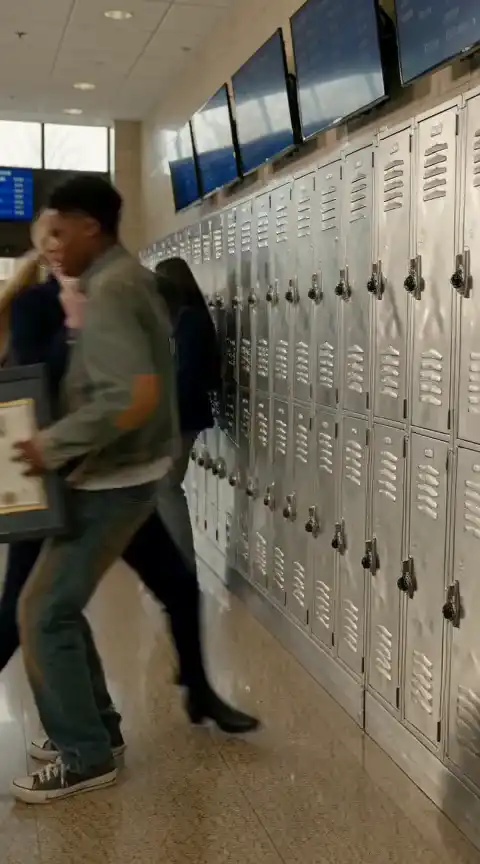
THEY THOUGHT THE SCHOLARSHIP KID HAD NOBODY IN HIS CORNER TO DEFEND HIM — UNTIL A SLEEK BLACK CADILLAC SEDAN PULLED UP OUTSIDE AND A MAN IN AN IMMACULATE SUIT STEPPED OUT.
The heavy thud of that car door shutting outside seemed to carry straight through the glass entryway.
Paisley did not let go of Quincy’s collar right away.
She kept him pinned against the locker face, her knuckles white, waiting for him to blink first.
“I asked you a question, Quincy,” she said, though her voice lacked the easy snap it had two seconds earlier.
Quincy didn’t blink.
He just kept looking past her shoulder, out toward the gray morning light bleeding across the station curb.
Through the revolving glass doors, a man stepped onto the station floor.
He was tall, with deep brown skin like Quincy’s, close-cropped silver hair at the temples, and an overcoat of charcoal cashmere cut so sharply it made the bustling terminal look rumpled by comparison.
He wore no badge, carried no luggage, and walked without the frantic rush of everyone else trying to catch the 8:15 express.
Two steps behind him walked a younger woman in a tailored navy suit holding an ultra-thin leather portfolio.
The concourse noise didn’t stop, but the pocket around the lockers began to thin out immediately.
People who lived in this city knew the look of real power, and it rarely came with loud shouting or flash.
It came with people who never had to raise their voices to clear a room.
Paisley’s friend Chloe lowered her phone two inches.
“Paisley,” Chloe muttered, tapping Paisley’s shoulder with the corner of her phone case.
“Hold on, Chloe, I’m not done with him,” Paisley snapped, not turning around.
She tightened her grip on Quincy’s collar, driving his shoulder blades once more into the metal panel.
“Your little scholarship board isn’t here to save you, Quincy.”
“Nobody in this station cares who you are.”
The man in the charcoal coat stopped exactly five feet behind Paisley.
He didn’t touch her.
He didn’t shout.
He simply looked at her hand twisted into the fabric of Quincy’s jacket.
“Take your hand off my nephew,” the man said.
The tone wasn’t screaming anger; it was the flat, quiet calm of a judge reading a routine order.
Paisley rolled her eyes and turned around with an irritated scoff already formed on her lips.
“Excuse me, whoever you are, this is private school business, so maybe you should mind your—”
The sentence died halfway up her throat.
She looked at the man’s coat, then at his face, then at the platinum signet ring on his right hand.
Her mouth stayed slightly parted, but no sound came out.
Quincy stepped away from the lockers the instant her fingers went limp.
He didn’t run, and he didn’t drop his shoulders.
He reached down calmly and picked up his leather shoulder bag, brushing a sliver of broken glass from the strap.
“Good morning, Uncle Arthur,” Quincy said.
“Good morning, Quincy,” Arthur Vaughn replied, his voice smooth as polished stone.
Arthur’s eyes drifted down to the floor.
He looked at the shattered glass, the fractured oak frame, and the torn gold foil of the regional award stamped under Paisley’s designer boot.
“Is this your composition award?” Arthur asked.
“It was,” Quincy answered.
“Miss Sterling felt it was unearned.”
Paisley finally found her balance, pulling her coat tight around herself and forcing a brittle laugh.
“He was blocking the walkway,” she lied, glancing back at Chloe and her other friend Hunter for backup.
Neither of them spoke.
Hunter had already pocketed his phone and slid a half-step toward the newsstand.
“He was loitering around our luggage,” Paisley continued, raising her chin.
“I was just telling him to move.”
“You slammed him twice into state property,” Arthur said without inflection.
“You destroyed a framed document bearing the seal of the New York Arts Council.”
“And your companions recorded the battery from two distinct angles.”
Arthur turned his head slightly toward the woman in the navy suit.
“Kendra, please secure the transit police supervisor and notify the station manager’s office.”
“Right away, Mr. Vaughn,” the woman replied, already tapping a sequence into her device.
The name echoed off the steel lockers like a dry slap.
Paisley blinked, her brow furrowing as a cold recognition began to crawl through her thoughts.
“Vaughn?” she whispered.
Before she could process the thought, the glass doors behind Arthur swung open again.
A heavyset man in a camel-hair coat hurried through, carrying two oversized leather travel bags and a boarding folder stamped with first-class priority tags.
It was Harlan Sterling.
“Paisley, what are you doing over here?” Harlan called out, his voice carrying the booming, self-important rasp of an agency executive.
“The private lounge is on the upper level, and we have the pre-board call in ten—”
Harlan stopped dead in his tracks.
His eyes locked onto Arthur Vaughn’s profile.
The color drained out of Harlan’s face so fast it looked like someone had pulled a plug beneath his collar.
The travel bags slipped from his fingers, hitting the floor with a dull, heavy thump.
“Mr… Mr. Vaughn?” Harlan stammered, stepping forward so quickly he nearly tripped over his own luggage.
Arthur did not turn around immediately.
He allowed the silence to stretch just long enough for Harlan to break into a visible sweat beneath the station’s fluorescent lights.
When Arthur finally turned, his expression was completely blank.
“Harlan,” Arthur said quietly.
“I did not expect to see you outside of Beverly Hills this morning.”
“I… we’re taking the morning train to the D.C. showcase,” Harlan said, his hands fluttering nervously toward his lapels.
“My daughter Paisley is performing the opening monologue for the regional junior delegates.”
He gestured proudly toward Paisley, completely blind to the tension vibrating between the teenagers.
“Paisley, sweetheart, come here!”
“Come greet Mr. Vaughn!”
“This is Arthur Vaughn, head of Vantage Point Studios.”




