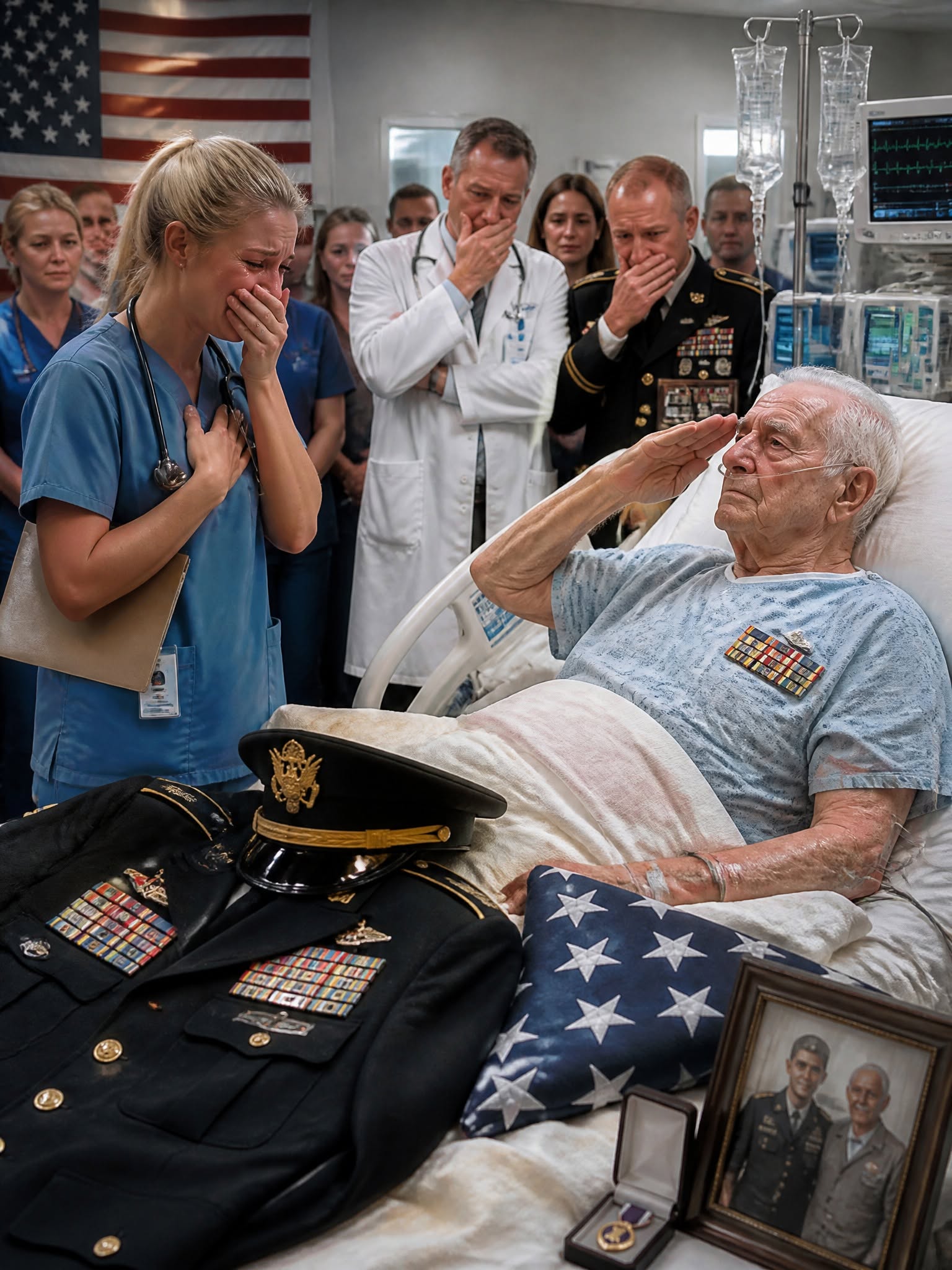
Grant Keller grabbed Clara’s ID lanyard and yanked it from her neck in front of the entire ICU team.
The plastic strap burned across her skin.
Her badge snapped free and swung once from his fist before he slapped it hard against the medical cart.
The sound cracked through the high-security veterans hospital room.
Behind him, two nurses smirked.
One physician looked away.
Another pretended to adjust an IV pump that did not need adjusting.
General Richard Whitmore lay motionless in the bed beneath the bright fluorescent lights, oxygen cannula resting beneath his nose, pale blue hospital gown pulled neatly over a chest that still carried the shape of old command even at eighty-eight years old.
His decorated dress uniform and white peaked cap lay across the foot of the bed.
A military ribbon rack rested against his chest.
An American flag stood on the wall beyond the cardiac monitor.
Clara Hayes took half a step back.
Not because she was afraid of Grant.
Because instinct told her not to grab at a man’s hands in a room full of machines, tubes, and oxygen.
She was in blue ICU scrubs, white sneakers, stethoscope hanging against her chest. Her blonde hair was pulled into a tight ponytail. Her eyes were exhausted and wet, but she kept her shoulders still.
Grant leaned closer.
Charcoal suit.
Dark tie.
Expensive watch.
The polished contempt of a man who had never stood beside a dying soldier long enough to learn humility.
“You’re suspended,” he said coldly. “Stop pretending that man knows you.”
The smirks widened.
Clara looked past him.
At the monitor.
At the dual IV bags.
At the rhythm strip.
Her humiliation left her face in one instant.
Something was wrong.
The cardiac monitor alarmed.
Not a soft warning.
A hard, urgent scream.
The rhythm on the screen twisted irregularly.
Dr. Evan Brooks moved first, reaching toward the defibrillator.
Clara snatched her badge from the cart with one decisive motion and turned toward the bed.
“No.”
Dr. Brooks ignored her.
He was already reaching for the paddles.
Clara stepped in, caught his wrist before he activated the equipment, and shoved the magnesium syringe tray toward him.
Staff recoiled.
Grant’s face flushed.
Clara’s voice cut through the alarm.
“Shock him now, and you may kill him.”
Dr. Brooks froze.
His eyes snapped to the monitor.
Then to the medication record.
Then back to Clara.
Grant grabbed Clara’s upper arm and tried to pull her away.
“You are done.”
Clara twisted free with controlled force, drove past him, and reached General Whitmore’s bedside.
His rhythm remained unstable.
His eyelids fluttered.
She leaned over him, two fingers at his pulse, eyes locked on his face.
For half a second, her professional control cracked.
Not in panic.
In recognition.
Deep.
Personal.
Buried.
“General,” she said, low and emotional. “Stay with me.”
His eyelids opened slowly.
Confusion clouded his pale eyes.
Then his gaze found Clara’s face.
Something changed.
Recognition moved through him like a light behind old glass.
His fingers trembled against the blanket.
The senior Army officer standing behind Dr. Brooks went completely still.
General Whitmore began lifting his right hand.
Weak.
Shaking.
Unfinished.
But unmistakable.
A military salute.
Clara’s eyes filled.
Grant’s face drained of color.
Dr. Brooks lowered the defibrillator equipment in stunned silence.
Every staff member who had smirked at her now stared as if the room had tilted beneath their shoes.
The general’s hand rose only halfway.
His voice came barely above breath.
“Still here…”
Clara did not answer.
Not aloud.
But her lips parted.
Her face showed restrained pain, discipline, and a grief so old it seemed to belong to another life.
The salute remained unfinished.
“Magnesium,” Clara said.
The word snapped everyone back.
Dr. Brooks blinked once.
Then moved.
“Two grams IV now.”
Clara adjusted the oxygen line and kept one hand near the general’s wrist, tracking the pulse.
“Check potassium. Review the last infusion. Stop the QT-prolonging medication.”
Dr. Brooks looked at the second IV bag.
His face changed.
“Who hung that?”
No one answered.
Clara did not look away from the patient.
“Answer him.”
Her voice carried more authority than Grant’s shouting ever had.
A young nurse near the pumps swallowed.
“I did. Per medication update from pharmacy.”
Clara glanced at the infusion label.
“Hold it.”
Dr. Brooks nodded sharply.
“Hold it.”
The nurse moved fast now.
No smirk.
No doubt.
Only shame and urgency.
Grant stood behind them with Clara’s lanyard mark still red across her neck and his own authority collapsing inch by inch.
“This is not your call,” he said.
Clara looked over her shoulder.
The whole room went still again.
“It became my call when everyone else ignored the monitor.”
Grant’s mouth tightened.
“You were suspended.”
General Whitmore’s fingers moved faintly on the blanket.
Not enough to speak.
Enough to hear.
Enough to know.
The senior Army officer, Colonel James Alder, stepped forward.
His dress uniform was black, medals aligned precisely. Until that moment, he had watched like an official witness trying not to interfere in hospital procedure.
Now his eyes were fixed on Clara.
Not suspicious anymore.
Not doubtful.
Calculating.
Remembering.
“Administrator Keller,” Colonel Alder said quietly, “I would choose your next sentence very carefully.”
Grant turned on him.
“This is a hospital matter.”
The colonel’s gaze went to the general’s half-raised hand.
“No,” he said. “It appears to be several matters.”
The magnesium entered the line.
The monitor kept alarming.
Then shifted.
Not normal.
Not safe.
But less chaotic.
Clara watched every beat.
Her breathing remained even.
No one in the room knew how much effort that took.
Because alarms do not only belong to hospitals.
Sometimes they belong to old rooms, old missions, old men bleeding under dust-colored skies while radios crackle with orders that do not arrive in time.
Clara blinked once.
Present moment.
ICU.
Fluorescent lights.
American flag.
General Whitmore alive beneath her hand.
She stayed.
“Pulse improving,” Dr. Brooks said.
Clara nodded.
“Keep him still. No stimulation.”
Grant took a step backward.
The movement was small.
But Clara saw it.
People like Grant loved procedure when it gave them power. They feared it when it turned into a record.
Dr. Brooks looked at him.
“Mr. Keller, I need this room cleared of nonessential personnel.”
Grant’s eyes widened.
“I am hospital administration.”
“You are not medically essential.”
A few seconds earlier, Brooks would never have said that.
Clara knew it.
Grant knew it.
The whole staff knew it.
Colonel Alder folded his hands behind his back.
“I’ll remain as the general’s authorized military representative unless the attending physician objects.”
Dr. Brooks looked at Clara without meaning to.
Then corrected himself.
“No objection.”
Grant stared at that tiny exchange.
The physician had looked to Clara first.
That would matter later.




