Act I
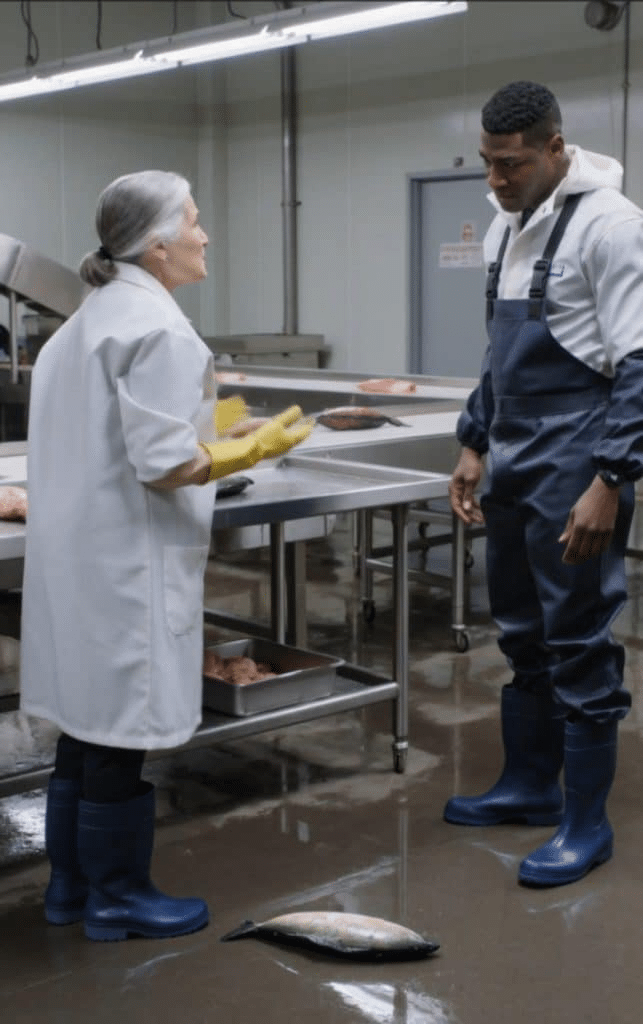
The fish slipped from her numb hands and hit the cold floor with a wet slap.
The old woman bent down immediately.
She was seventy, wrapped in a cold coat and rubber gloves, her fingers stiff from hours under industrial lights beside stainless steel tables and ice bins. Around her, the conveyor hummed steadily, carrying seafood down the line while workers in protective gear moved with the tired precision of people trained to keep up or fall behind.
“My hands are numb. I’m sorry.”
Her voice shook from the cold more than fear at first.
The mistake was small.
One fish.
One second.
Fixable before it reached anything else.
She reached for it carefully, already trying to remove it from the wet floor, already trying to correct the problem before it slowed anyone down.
Then the foreman rushed over.
His clean protective gear looked almost untouched by the work around him. A radio clipped to his chest crackled softly as he stepped into her path, his boots scraping against the slick floor.
He looked at the dropped fish.
Then at her bent back.
Then at the workers watching.
His face hardened.
“Trash. You contaminate my line.”
The old woman flinched as if the word had struck before his boot did.
“I was picking it up,” she said.
But the foreman was not listening.
Speed mattered to him.
Numbers mattered.
The rhythm of the line mattered.
The woman freezing through another shift did not.
And in front of the entire packing floor, he decided one dropped fish gave him permission to turn a small mistake into public punishment.
Act II
He kicked the fish away first.
It skidded across the wet factory floor, sliding beneath the glare of the industrial lights.
Then he drove a hard kick into the old woman’s chest.
She fell beside the stainless table.
The sound of her body hitting the cold floor made the closest workers gasp. A plastic bin rattled against the table leg. The conveyor seemed to keep moving for one more second, then the whole line felt like it stalled under the weight of what everyone had just seen.
Her elbow scraped the surface as she landed, leaving only a small light-red mark, brief and non-gory.
She tried to breathe through the shock.
Her rubber-gloved hand pressed against the wet floor.
Her coat clung to her shoulder.
For a moment, she looked more confused than hurt, as if she could not understand how a workplace mistake had become an attack.
That made it worse.
She had not argued.
She had not refused.
She had apologized.
The foreman stood above her, still angry, still pretending the dropped fish was the real offense.
“Trash. You contaminate my line.”
My line.
The words revealed him.
Not the company’s standards.
Not worker safety.
Not food handling.
His line.
His speed.
His authority.
His chance to humiliate someone weaker than him in front of people too afraid to intervene.
The old woman tried to push herself up.
The foreman stepped closer.
Exactly two forceful follow-up impacts landed while she was down, one toward her back and one toward her rib area. The frame stayed wide and non-gory, but the cruelty was unmistakable in the workers’ faces and in the sudden silence around the tables.
Then he leaned over her.
“Old hands don’t belong on fast lines.”
Outside, heavy brakes cut through the factory noise.
Act III
The black executive convoy stopped outside the plant.
The sound reached the production floor before the people did.
Tires hissed against wet pavement.
Doors opened.
Footsteps approached fast.
Then the production door slammed open with a hard metallic bang.
Everyone turned.
A man of sixty-two stepped inside with a top operations team behind him. He wore the silence of someone who did not need an introduction, and the air changed the moment he crossed the threshold.
Supervisors straightened.
A shift lead went pale.
The foreman turned, still holding his anger like a shield, until recognition cracked through his face.
The owner’s eyes moved across the room.
He saw the line.
The stainless steel tables.
The workers frozen in protective gear.
The fish on the floor.
The elderly woman down beside the table.
The foreman standing too close.
His expression did not flare.
It hardened.
That was worse.
He walked directly toward the old woman, ignoring the foreman completely.
The operations leaders followed behind him in a tight, silent group. No one spoke. No one defended the supervisor. No one asked for a report before looking at the person who had been hurt.
The owner reached her first.
He lowered himself carefully near the wet floor, shielding her from the foreman’s side of the aisle. His attention stayed on her breathing, her posture, the small scrape on her elbow, the shock in her eyes.
Only after she was protected did he rise.
He stepped between her and the foreman.
The operations team stood behind him.
The packing line went still.
And suddenly the man who had ruled by speed found himself measured by something far heavier.
Act IV
“You just crossed the final line.”
The owner’s voice carried across the factory floor.
Quiet.
Cold.
Final.
The foreman’s mouth opened, but no words came out at first.
He looked toward the operations leaders behind the owner, searching for some sign that procedure might save him. There was none.
The dropped fish still lay on the floor.
A small, fixable mistake.
The elderly worker remained behind the owner.
A human being.
The difference was brutal.
“She contaminated the line,” the foreman finally said.
The excuse sounded smaller than the hum of the equipment.
Workers stared at him now, not with fear, but with the first fragile edge of recognition that someone else had seen what they lived with.
The owner did not look at the fish.
He looked at the wet floor.
At the cold tables.
At the old woman’s shaking gloves.




