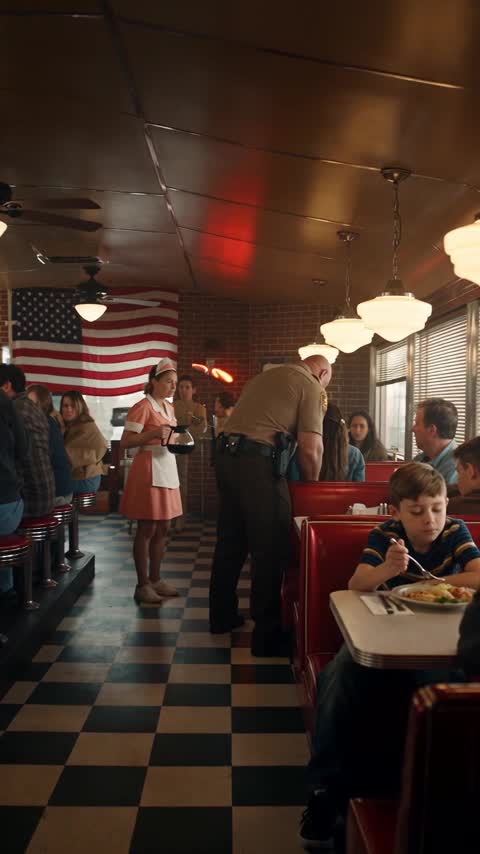
“Chapter 1: The Weight of Cold Steel
The chrome rim of the pie carousel rotated with a faint, rhythmic squeak that had kept time in the Blackwood County Diner for forty years. Outside, the midday Georgia heat shimmered off the cracked asphalt of Highway 17, bending the pine trees into warped, wavering silhouettes. Inside, the air smelled of burnt chicory coffee, griddle oil, and the crisp, ozone tang of an ancient air conditioner on its last legs.
Amara Whitlock sat in a corner booth, her back straight against the cracked crimson vinyl. She was forty-four, wore her box braids swept neatly over one shoulder, and was dressed in an unbranded charcoal tank top under a faded denim jacket. She had paid for her plate of scrambled eggs and skillet potatoes with a crisp twenty-dollar bill, leaving an eight-dollar tip beneath the salt shaker.
She had not touched her second cup of black coffee when the front doors swung open with enough force to rattle the plate glass.
The bell above the lintel didn’t chime; it shuddered.
Sheriff Dalton Voss stepped across the threshold, his immense frame blocking the blinding noon light. Behind him trailed Deputy Jesse Vance, a lanky young man with a peach-fuzz jawline and a duty belt that looked two sizes too large for his hips. Voss, however, wore his uniform like an executioner wears his hood—with a suffocating, deliberate permanence. His silver five-point star was pinned directly over a chest as wide as an oak sideboard, and his heavy combat boots struck the linoleum with the measured authority of a man who believed the earth beneath him existed solely by his permission.
The diner fell into a sudden, suffocating hush. Across the counter, an elderly farmer lowered his coffee mug, his knuckles turning white as he stared down at his saucer. The waitress, a tired woman with auburn hair pinned back with plastic barrettes, shrank into the kitchen doorway, letting the order wheel swing shut.
Voss didn’t look at any of them. His cold, pale blue eyes scanned the dining room once before locking directly onto Amara.
Amara did not look away. She picked up her fork, collected a small portion of potatoes, and lifted it to her mouth. She chewed calmly, her eyes fixed on the sheriff as he closed the distance between the entryway and her booth.
“Hands on the table. Both of them. Flat,” Voss barked. His voice was a rasping baritone, heavy with thirty years of cheap tobacco and absolute authority.
Amara chewed, swallowed, and dabbed the corner of her lips with a paper napkin. She did not lay her hands flat. She kept them folded loosely above her lap.
“Good afternoon, Sheriff,” she said. Her voice was moderate, smooth, and devoid of the frantic tremor Voss was evidently accustomed to hearing. “Is there an issue?”
“I gave you an instruction, lady,” Voss said, stepping directly up to the edge of the booth. He towered over her, his shadow cutting off the sunlight from the adjacent window. “You don’t talk back to me in my county, and you sure as hell don’t ignore an order.”
Before the sentence had finished echoing off the low tin ceiling, Voss leaned across the table. His massive, calloused hand shot out, grasping Amara by her upper left arm with enough crushing force to bruise the muscle through the denim sleeve.
The diner gasped. The farmer at the counter flinched, his eyes darting to the floor.
Amara did not scream. She did not wince. She simply let her body move with the pull, keeping her center of gravity low, her mind registering every physical detail with clinical precision. *Excessive force without prior verbal identification of a crime. Section 1983 liability,* she noted silently. *Failure to establish reasonable suspicion prior to physical seizure.*
“Hands behind your back, right now!” Voss snarled, dragging her halfway out of the booth.
“You want legal cause?” Voss sneered, his breath hot against the back of her neck, smelling of stale mints and burnt tobacco. He reached down with his right hand, unholstering a pair of heavy peerless handcuffs from his tactical belt. “You match the description of an armed robbery suspect out of Wayne County. And right now, you’re actively resisting a peace officer.”
He seized her left wrist, twisting the joint upward toward her shoulder blade until the ligament stretched taut. The cold, nickel-plated steel bit savagely into her wrist bone with a ratcheting click.
“I have not resisted,” Amara replied, breathing evenly through her nose. “I have made no sudden movements. I have complied with every lawful physical demand while requesting statutory justification.”
“You talk too damn much,” Voss grunted. He yanked her right arm back with savage momentum, slapping the second cuff closed until the teeth locked into the deepest notch. He squeezed the metal tight enough to leave immediate purple indentations on her skin. “Deputy! Grab her effects.”
Deputy Jesse Vance hesitated for half a second by the booth’s edge. His eyes were wide, darting nervously between the silent locals and the woman pinned under his boss’s immense forearms.
“Vance! Pick up the damn bag!” Voss roared.
“Yes, sir,” Vance stammered. He reached into the booth and scooped up Amara’s black pebble-grain leather purse. It was heavy, well-made, and fastened with a discreet brass clasp. Vance slid the long leather strap over his shoulder like a schoolboy carrying a satchel.
Voss didn’t give Amara time to find her footing. He grabbed the chain connecting the two cuffs and jerked it upward. A sharp, searing line of pain flashed through Amara’s shoulders, but she did not give him the satisfaction of a groan. She rose to her feet, finding her balance immediately, her posture rigid and her chin lifted high.
The patrons watched in paralyzed dread. For three years, rumors had filtered through the southern circuit about what happened to motorists who passed through Blackwood County—particularly Black travelers, commercial drivers, or anyone who didn’t carry an in-county bumper sticker. Vehicles seized under civil asset forfeiture. Bail bonds set at ten times the statutory maximum by a compliant magistrate who was Voss’s first cousin. People disappearing into the concrete basements of the county annex for forty-eight hours without a single phone call, emerging only after their bank accounts had been drained into the sheriff’s department discretionary fund.
Amara had read every single one of those twenty-four sealed affidavits in her chambers on the eighth floor of the Richard B. Russell Federal Building in downtown Atlanta. She had sat through three secret briefings with the Civil Rights Division of the Department of Justice, listening to investigators explain that they couldn’t get an undercover agent close enough to Voss because the man owned every telephone pole, judge, and tow truck within forty miles of the county line.
So, she had taken a week of her accrued judicial leave. She had rented an unassuming gray sedan under her middle name, left her security detail in Fulton County, and driven south down the two-lane state routes alone. She had wanted to see it with her own eyes. She had wanted to know if the terror was real, or if it was merely the exaggerated grievance of people caught on the wrong side of the law.
Now, she had her answer. The steel around her wrists was real. The cruelty in Voss’s eyes was real.
“Walk,” Voss commanded, shoving her between the shoulder blades.
Amara walked. She kept her stride even, her head level, looking neither to the left nor the right as she was paraded past the frozen customers. Voss pushed her through the glass doors, the heat hitting them like a wet, heavy quilt the moment they crossed the threshold into the parking lot.




