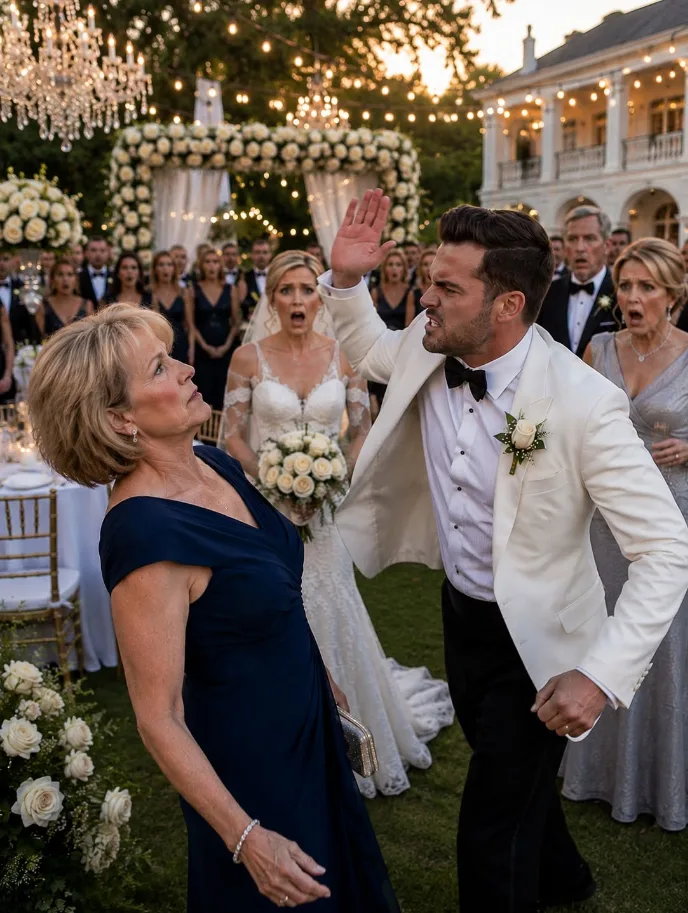
La gifle résonna dans la salle de bal à coupole de verre du Grand Regency Hotel comme un coup de feu.
La musique ne s’est pas simplement éteinte ; elle a disparu instantanément. Les conversations mondaines se sont dissipées dans un silence absolu. Les coupes de champagne sont restées figées à mi-chemin entre les lèvres maquillées de rouge à lèvres, et deux cents paires d’yeux se sont fixées sur la table d’honneur au centre de l’estrade.
J’ai trébuché en arrière, les talons de mes escarpins vintage s’accrochant au sol en marbre poli. Ma colonne vertébrale a heurté le bord de la table des cadeaux recouverte de velours, faisant s’éparpiller des piles d’enveloppes dorées sur le sol. Des verres en cristal ont tinté violemment derrière moi. La douleur physique à ma joue gauche était une brûlure vive et lancinante, mais mon esprit était étrangement détaché, calculant la force du choc. Soixante-deux ans, veuve, et frappée comme une bête sauvage devant tous ceux que j’avais connus.
Preston Sterling se tenait devant moi, vêtu de son impeccable smoking blanc, lissant le revers en soie de sa veste d’un geste sûr et méticuleux. Il ne semblait ni paniqué, ni coupable. Il me fixait du regard, comme si frapper sa belle-mère le jour de son mariage n’était qu’une corvée administrative désagréable qu’il avait été contraint d’accomplir.
« N’envenime pas les choses, Lydia », dit Preston d’une voix grave et posée, suffisamment forte pour être entendue au premier rang. Il me tendit une main gantée, paume vers le haut. « Donne-moi les clés de la ferme. Tu as signé l’acte de fiducie prénuptial jeudi. Le terrain sera transféré à Sterling Holdings après le mariage. C’est réglé. »
Mon corps tremblait, mais je ne baissais pas les yeux. Je regardai à côté de lui ma fille, Sarah.
Elle restait figée dans une robe de dentelle sur mesure à six mille dollars que j’avais passée trois mois à retoucher à la main. Son maquillage de mariée était impeccable, mais sa peau était devenue complètement exsangue. Ses mains, tenant un bouquet de pivoines blanches, tremblaient tellement que les pétales tombaient les uns après les autres sur le sol.
« Maman… s’il te plaît », murmura Sarah, sa voix à peine audible par-dessus le bourdonnement de la climatisation de la salle de bal. « Donne-lui juste les clés. Tu l’as promis. Tu as dit que tu voulais que je sois heureuse. »
Ça faisait plus mal que sa main n’aurait jamais pu le faire.
A wave of nausea hit me, cold and heavy. I looked at Sarah and saw not the twenty-six-year-old woman standing beside a predator, but the six-year-old girl who used to run barefoot through four hundred acres of high-yield cornfields, laughing as the autumn dusk settled over the ridge. I saw the girl who used to sit on the fender of a rusted John Deere tractor while her father, Robert, wiped grease from his forehead and taught her how to check an oil line.
Robert had built our farmhouse board by board after the 1998 tornado leveled the original structure. He had poured the concrete footing with his own bleeding hands. When the agricultural crisis hit in 2008 and our neighbors lost everything to the big regional banks, Robert worked twenty-hour days, sleeping in his truck between shifts at the grain elevator, just to ensure that dirt stayed in the Bennett name.
When Robert died four years ago, Preston Sterling had come to the funeral dressed in an Armani suit, acting like the sympathetic young real estate developer who just happened to be dating my daughter. Back then, he called those rolling green hills and timber stands “a lovely piece of useless rural nostalgia.”
Then, eight months ago, the state Department of Transportation finalized the map for the Interstate 80 bypass corridor.
The primary interchange—a multi-million-dollar logistics hub complete with commercial rezoning—was designated to cut directly through the southern perimeter of the Bennett farm. Overnight, four hundred acres of “useless dirt” became forty million dollars in raw commercial real estate.
Preston’s mother, Cassandra Sterling, sat at table one, draped in sapphire silk and multi-carat diamonds. She raised her crystal flute, taking a slow, deliberate sip before giving me the cold, practiced smile that defined the Sterling family name.
“This is embarrassing, Lydia,” Cassandra announced loudly enough to echo off the ballroom rafters. She didn’t bother standing. “You are sixty-two years old. You are a widow living alone in a house with dry rot. Surely you didn’t imagine you had the mental or financial capacity to manage a multi-million-dollar development corridor. Be reasonable. Hand over the brass key.”
A ripple of quiet, cruel laughter drifted from the tables hosted by the Sterling Enterprises board members.
I reached up, wiping a bead of crimson blood from the corner of my lower lip with the back of my hand. I pulled myself upright against the gift table, my posture straightening inch by inch until I was standing at my full height.
I looked Preston directly in the pupils. “You really believe you’ve won, don’t you?”
Preston’s jaw flexed. The arrogance in his eyes flickered, replaced for a fraction of a second by a cold, calculating annoyance. “You promised Sarah a wedding gift, Lydia. The farm is the gift.”
“I promised my daughter love,” I said quietly. “And a mother’s protection.”
“Love doesn’t pay six-figure back property taxes, Lydia!” Preston snapped, stepping closer, his shadow falling over me. “And protection doesn’t stop bank foreclosures. You’re broke. You’re drowning. Hand over the keys, or I swear to God I will have you escorted out of this venue by private security for disturbing the peace.”
I looked down at the smear of red on my knuckles, then back into his face.
“No,” I said, my voice cutting through the silent room with an icy clarity that surprised even me. “Property taxes can be managed. But greed always leaves a trail of evidence behind.”
Preston froze.




